Sunday, December 13, 2009

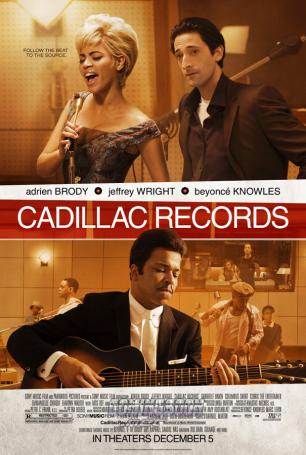
Cadillac Records - % % %


Meh. Nothing special.

and that is a tragedy. I'm glad that millions of people will learn some of the profound history of Chess Records from this film and it has reminded me of some music that I have neglected to purchase. But the deep, powerful, universal themes of the music and lives of the people who built the house of Chess Records are not effectively portrayed by this film. It's there in the screen play and the acting comes close to being affecting. But by encompassing all of the characters from Len Chess to Chuck Berry, no one's story gets told very well.

And I feel that this is a little petty, but Beyoncé should have tried harder to imitate Etta James rather than relying on the vocal techniques that distinguish her own career. It made the second half of the film a modern reinterpretation of the music, and mirrored the challenge facing the original artists as those like the Beach Boys and Elvis delivered paler versions of their work. Beyoncé's versions of James' classics just feel plastic and cheap, like a crappy toy manufactured in China, rather than the original word-carved creation that your grand-dad played with. She does a decent job with the acting but is not believable as a junky. She doesn't gasp the true well of sorrow that James could access in her songs.

Jeffrey Wright knocks another performance out of the park. That man is simply amazing. He is a true chameleon. He is extraordinary in transforming himself into another person so far from his own life in aspect and quality, while at the same time creating an inner world of extreme depth and vastness. I stand amazed by him again.

As for Adrien Brody, he was wonderful in The Pianist, but this is another film that shows what an exception that film is. Perhaps he was not given the material to flesh out or the direction to force him to greater depths, but the depiction of Len Chess felt flat and cursory. This character felt common and too familiar. The hardworking business man who was never home and struggled to maintain success. The moments that evidence the extraordinary character of Chess don't seem to translate into the man himself and feel just like logical indications rather than truthfulness or innate qualities.

All in all, it wasn't a terrible movie. It was competently written and directed by Darnell Martin, a rare female director working in Hollywood. But this film lacks the potent emotion and deeper psychological complexity she has shown herself capable of with her break-out film, I Like It Like That (1994). It seems all of her work in television serials, like Law & Order, has done her great harm as a director since this film suffers greatly from an efficient pace and frugally clean direction.

Sunday, November 22, 2009

The Men Who Stare at Goats - % % % %


My web-review was selected as part of the Rotten Tomattoes Show on CurrentTV episode airing on Nov. 13, 2009, which was very exciting for me.

You can find it on the Rotten Tomatoes Show's website.

And here's the complete review I submitted to them.

Saturday, November 21, 2009

Blindness - % % %


While this is an interesting concept, the entire world suffers from a contagious disease that induces a form of blindness, the execution fails at points and the dismal view of the ensuing conflict hits a few false notes. In the end, following how society breaks down is always an interesting exercise and I was engaged until the end.

The main characters are a couple played by Mark Ruffalo and Juliane Moore. Ruffalo plays an optometrist, who the first victim visits for help. Moore plays his wife and from the first scene with them together we are to infer that she is a neglected and shy housewife, and that their marriage is not filled with passion or much warmth. If their relationship had been better developed in the beginning, it might have made the rest of the film more engaging than an exercise in curiosity. Ruffalo does a descent job showing his character's struggles and emotional complexities, but Moore fails to connect with the audience's sympathy as she forges on, bearing enormous responsibilities without any joys or pleasures. She suffers in silence and when she does fall to tears, it has no power, but reminds me of other scenes from Boogie Nights and Magnolia when her tears affected me deeply. Here she feels too distant, drowned out by the extraordinary spectacle of an entire society collapsing around her.

The film is set in an unnamed urban location with unnamed characters. The execution of this is excellent and the feeling of a multicultural metropolis is achieved with remarkable skill by director Fernando Meirelles. Much of the film is in gray tones, and through glass and steel and mirrors, we see the civilization fall apart. Immediately the sick are quarantined in substandard facilities with no staff to attend to the newly blind. They are herded in and abandoned to care for themselves with occaisional deliveries of food. The film gets very dark very quickly. As the hoards of new victims enter the facilities the lack of institutional structure leads to a de-evolution in the small society.
A man (Gael Garcia Bernal) declares himself king and his male dominated wing take control of the food supply. They demand all the valuables from the others in exchange and then they demand the women. The decent into this abhorrent anarchy forces questions into one's mind, attempting to find ways out of this situation. But these means and avenues are not fully explored and the violence is not convincing enough to accept the plot at this point. The consequences do feel natural and a final twist brings the entire situation crumbling to ashes.

At this point the few characters we have come to know form a small family who exit the facility into a totally abandoned and collapsed city. The world has fallen apart and much of the city is abandoned to roaming and staggering groups of the blind. After the first section of the film, the silence and sparseness feels a great relief. What could feel long and drawn out, is a fine easing of the tension into the final resolution. I commend the filmmakers for restraining themselves. In another film, like City of Men, it could be one trauma after another. In Blindness however, the destruction leads to silent scavengering and eventually to the creation of a refuge. The happy ending is earned, although leads this audience member to question the purpose of the exercise in the first place. If it all works out in the end, did the couple and their accompanying new family need to suffer through all of this to find a real appreciation for family? Is that the value in this epic journey? Perhaps if the villains had been better developed psychologically, I might come to feel more confident that loving and caring for one another is the true answer. But since this is based on a Jose Saramago novel, I am not surprised that there is little character development. In this translation into a two hour film, the story might have been aided by a bit more standard psychological development. Saramago can get away with nameless characters because we can enter their heads and read their thoughts slowly over the course of several hundred pages. In a film, a bit more is required to understand how a man can become so cruel and selfish, and if it is that he is simply selfish that makes him cause so much evil, as in Bernal's character.

Saturday, September 19, 2009

Il ya longtemps que je t'aime (I've Loved You So Long) - % % % %


A brilliant concept for a character-driven drama, Kristen Scott Thomas plays Juliette who moves in with her sister's family after 15 years in prison for murder. Her sentence comes out pretty early in the film, so I don't think I'm ruining anything by telling you that she killed her son when he was six. It's a remarkable story of the struggles of resiliency. How does one go on after something so horrible and then after losing so much of one's life in such a shameful and impossible to understand manner?

Kristen Scott Thomas is excellent. Really excellent. Her eyes hold a well of sadness known particularly to those who have lost their children.

The script is excellently written and directed by Phillipe Claudel, including paralleling stories and characters that broaden the main plot and elaborate upon Juliette's journey. She is befriended by her parole officer who suffers from his own demons. Her sister, well played by Elsa Zylberstein, has two young daughters of her own whose mere presence continually emphasizes the conflict and develops opportunities for inter-character conflicts. She has chosen to adopt because of her fears after her sister's actions. It is profound how our actions lead to the understanding of our younger family members' worldviews and this is a deftly woven example. As Juliette is developed, set pieces illustrate and remind the audience of her struggles, from wheelchair bound extras to the new birth of a friend's child. Again and again, she must revisit how her life will always be different and similar to others. It's magnificent at times.

And yet, there are moments that are too heavy handed. A friend tells her that he doesn't judge her because he worked in a prison once and has learned that we, the free and the convicted, are all the same. Oh, brother. It's already clear after explaining that he worked in a prison for a time, but he goes on and explains it all so unnecessarily. It's too bad because it's otherwise a wonderfully tender and hopeful moment. There are others included in the film and still more in the extras' deleted scenes. I wish they had cut just a little bit more. The film could have soared even higher.

All in all it's very very good. I put off watching it because I thought it'd be too depressing and, while there is a deep sadness to it, the film is extremely hopeful. This is not misery-porn like Cherrie Baby or some Lars Von Trier sadistic parade of emotional torture. Kristen Scott Thomas' reserve becomes a force of strength and hope and the surrounding cast is a crew of some of the best people one could ever hope to know. Perhaps a bit too optimistic, but there are plenty of judgmental side characters for balance. It never feels too cheerful. It is true that spending an evening with a bunch of kids running around a beautiful home and walking around a vineyard with a bunch of intelligent friends is wonderful and it does regulate the dreariness of life. This is a character who, like her social worker and parole officer say, is very lucky to have family. And through these thoughtful adult relationships and the bonds of communal, daily, family living, a very wounded soul can be a resource of love and support as well. And maybe live happily ever after too. Well, can live ever after, which is often the best we can reasonably hope for, and that's OK too.

Tuesday, September 8, 2009

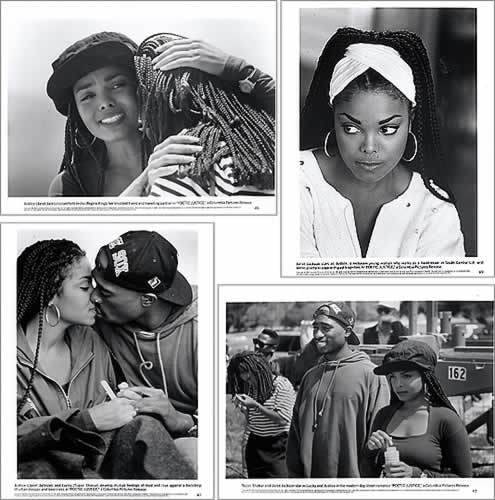
Poetic Justice - % % %


The script is just way too contrived, much like the title. A film about a girl named Justice who writes poetry named Poetic Justice. Ouch. Add to this that the characters are too erratic to feel like real people, let alone anyone you'd want to care about.

Spoiler
The film follows Justice and her friends as they travel from LA to Oakland on a road trip. The film opens as Justice (Janet Jackson) loses her not so great boyfriend (Q Tip) in the very first scene. He gets shot in the head, the blood flying onto her. The scene is typical of the film. The characters simply go back and forth, shouting, kissing, fighting, without much underlying arc. Their personalities and moods simply serve to move the plot along too conveniently. And the plot has ridiculously unnecessary sections like the stop at the carnival. I can see that in editing it was decided to keep the section because it develops the relationship between Justice and Lucky, but it should have been obvious in the screenplay that it felt especially gimmicky after a similar side-story at a family picnic. And then

Justice and her love interest, Lucky (Tupac Shakur), have vulnerable moments, but the rest of the cast are shallow, often heartless and cold. It may be that Singleton wanted to show the various people like this, but it is a harsh statement from a man who knows that he is a rare cinematic voice of the African-American community. Justice's best friend, Iesha (Regina King), and her boyfriend, Chicago (Joe Torry), are particularly juvenile and trifling characters. Regina King has become a fantastic actress, as noticed in Ray. But these characters are ridiculous. Iesha's moment of vulnerability happens quickly. Suddenly after vomiting and being told that her drinking is a problem by her best friend, she comes around and makes a sweeping apology. It's a terrible scene on many fronts. Later she and Chicago break up in a violent fight, instigated by his lack of stamina at sex. It's pathetic for both characters. Is Singleton using these two as a foil for the better love between Lucky and Justice? If so it is too strong a contrast, and they are too awful as people for anyone in the audience to learn any lessons from.

In comparison with his later films, like Baby Boy, I could just chalk this up to youth and immaturity. He was 24 when he made Poetic Justice, so fair enough. That's impressive. There are kernels in the film, especially Janet Jackson and Tupac's performances. They have real chemistry. Justice's character is buoyed by the poetry of Maya Angelou, whose performance and role in the film as a family elder is unfortunately awkward and forced. The film as a whole lacks subtlety and sympathy, let alone a script editor. But there are so damn few films about young black Americans, I'll take what I can get.

Furthermore, I love that it is a respectful story about a postman and a hair-stylist. I think we should revel more often in the stories of more average people. Don't get me wrong that I think film should always reflect reality, but looking at even the indie films of this summer, very few revolve around any people remotely modest or average in their occupations.

Inglorious Basterds - % % % %

Ridiculous.


I could just leave it at that. Fun, funny, gory. I'm still mulling this one over.


What's the point of this movie? Is it that revenge is essentially wish fulfillment, as is much violence? Hollow, fun, and leaves you with a skip in your step but little else?

The ridiculousness permeates every little bit of the film. "Once upon a time... in Nazi occupied France" opens the film, establishing that this is a fairy tale, and a preposterous one at that. Brad Pitt as a hillbilly scalping sergeant. Eli Roth as the Bear Jew who beats Nazis to death with a baseball bat. That's some brilliant casting. I loved the musical selections. I laughed so hard when Bowie's theme from Cat People played to the Jewish heroine prepares seductively for her night of revenge. It's so over the top, I'm not sure how to take it. The most brilliant part of the film is the use of nitrate film stock as an explosive. That's a genius metaphor. Film exacting an eruptive revenge while the heroine laughs maniacally immediately following her gruesome death.

I'll write a more coherent review soon. I just had to get something down. So ridiculous.

Sunday, September 6, 2009

Comments

If you have read any part of this, would you please leave a comment? I'd like to know if anyone has checked this out and if I ought to tailor it for an audience or if it should continue as an exercise for myself. Thanks!