Showing posts with label % %. Show all posts

Thursday, May 26, 2011

Sister Kenny (1946) - % %


Why are biographic films so terrible? "Sister Kenny" is the heroic tale of an Australian nurse, played by Rosalind Russell, who discovers an unorthodox treatment for polio. Kenny is noble and resolute. Early in her life she considers leaving nursing to marry, but the children command her attention. She is practically made of granite. Her methods meet extreme resistance from doctors, all men, embodied in one figure, Dr. Brack, a mean old buzzard who dismisses her because she doesn't have a medical degree, reserved solely for men.

It's interesting to learn about the evolution in the treatment of polio, but as a film this is terrible. Kenny is clearly an excellent person from the beginning and Russell plays her as a stoic champion. She does attempt to exude humility and passion, but each of these deviations from the stoic quality serve to exaggerate her saintliness. It's a waste of time. There's no drama. Even as she stands up to the medical establishment, it isn't a real argument but rather a bombastic declaration of her greatness against an argument better elucidated an hour earlier in the film. It's repetitive and uninteresting. It is remarkable that the real Elizabeth Kenny faced so much resistance and it does remind me that medicine is not an exact science, but full of tradition and prejudices. The real Sister Kenny had a remarkable life and her story holds interest for history lovers, but the film makes this groundbreaking woman seem wooden.

Saturday, September 5, 2009

Julie & Julia - % %


Yes, after a summer of watching nearly nothing, I watched this. It was cute at points and not as annoying as some (male) reviewers have made it out to be. I won't say much because there isn't much to say.

The film revolves around a sad twenty-something who wants to be a writer but like many has not been able to find a way through hard work and tenacity to accomplish her goals and so has a temp job. It's a legitimately depressing temp job. Well they all are in legitimate ways, essentially depressing, but this one involves attempting to assist the survivors of the World Trade Center attacks. But instead of finding inspiration in her work, Julie finds it in an exercise. She decides (with the help of her shallowly depicted husband whose only characteristic, aside from being saintly, is to not like having it rubbed in his face) to begin a blog of cooking all of the recipes from Julia Child's famous book on French cooking.

And so begins Julie's creation of Julia Child in her imagination. Meryl Streep is obviously, unsurprisingly wonderful. But the plot lines with her would have been more interesting as a documentary I might watch on PBS one Sunday afternoon. She sounds much more interesting than the parallel story of the imagined Julia and the real life Julie, a simple woman without much to deal with in real life except her own underdeveloped self. So she develops herself into a better cook and a sometimes writer. She faces obstacles. Things don't always go her way. But eventually she gets profiled in the New York Times and gets a book deal. She apologizes to her bland husband and all ends happily. Yawn.

The only interesting thing I've found about this film is that Ben and Ben on At the Movies thought that Julie was whiny and childish. That's not too far from the truth. What makes this character different than say any Meg Ryan character ever is that Julie doesn't have anything going for her. I can't imagine why her husband married her. Since the book is autobiographical, apparently the author doesn't get it either. And the process of getting Julie to a place where she becomes someone of interest is painful because it illustrates a theory of mine that schooling doesn't really develop adults, life does. And much of schooling is structured to prevent maturing. Intense academic rigor should perhaps be reserved for the more matured and young adults should staff gas stations and janitorial closets and learn a bit more about themselves and life before getting fabulous educations. Then when they graduate from Barnard they perhaps won't spend eight years temping and feeling like failures.

Wednesday, May 20, 2009

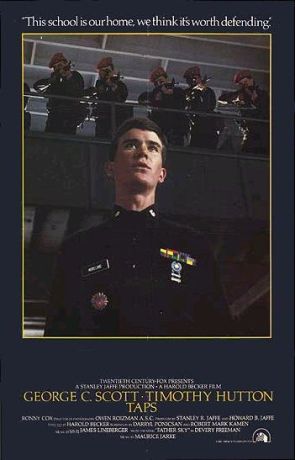
Taps - % %


I am sad to say that I am disappointed by this film, because I remember it being a big deal when I was growing up and I recall my brother liking it alot. I love teen films, and I love survival stories, like Red Dawn. But this film's love of tradition fails the main thrust of the narrative as it marches head long into anti-social territory.

And I disagree with Roger Ebert, which I also find sad, since I generally find so much coherence in his reviews.

It starts out well. Timothy Hutton, Sean Penn and George C. Scott are great.

But Tom Cruise is just a douchebag. How could any of the other cadets be friends with such a jerk. It struck me as odd at first, but I wrote it off as perhaps something I don't understand about boys or military schools. I supposed that at a boarding school that everyone learns to love something about each other in such a closed environment. Who finds that guy attractive? I don't get it. (Btw I have always felt like this and it is not a result of his bizarro behavior in the past few years.)

Ebert makes an analogy between the school in which Taps is based and Lord of the Flies, which are a book and films that I love. I appreciate this analogy and it holds until 2/3s of the way into the film when the story gets stuck.

The students hold their military school with weapons and barricades against the state guard who want to close the school and send the boys home. Timothy Hutton is the head cadet, Sean Penn is his booksmart best friend with existential issues. Tom Cruise is their cohort who is tough and ruthless.

Evan Handler is great as another friend who doesn't seem so gung-ho. His character isn't so easily typed, but he comes off as a good guy. And so cute as a young kid! Cute as a grown up too, imo.

spoiler alert
So in the end a youngster gets killed accidentally and Hutton berates himself. There is a nice moment when his character talks about how it feels to hold a dead boy in his arms and to just think about what a neat kid he was. It's tender and it works. So the conscience of the film, Sean Penn, talks him into declaring victory and just going home. As they bring all the boys in to end the stand off, Tom Cruise's character decides to shoot the commanding officer of the state guard and then grabs an automatic gigantic gun and just goes nuts. He says, "It's beautiful, man!" just before he and the intervening Hutton get killed. I agree that there are kids who just want to go for it and enjoy the exhilaration of violence, who would have a hard time backing down. What's wrong with this kid, though? What did he learn that no one else did? Or if this is a possible result of the military education system, there needs to be a serious overhaul.

So we're left with a parallel between Hutton and Cruise. Hutton was rewarded because of his diligence and reserve, whereas Cruise, who led the red berets, was too rigid to be able to fully succeed. There is an acknowledgment then, from the beginning, of Cruise's character's limitations and troubles. But there is still a place for such a boy in the military. It's only in the end that a boy like this can't be trusted or must be killed. That's a strange message to end a film with.

The film ends with two deaths, both the result of a young man taking charge of a situation and entrusting other young men with responsibility. Essentially Hutton's character does a great job. Things go wrong because accidents happen, the first death was a result of escalated terms of the stand off. The last deaths happen because young people are ... what? Erratic? Untrustworthy? Thrill-seekers? Or is it that life hasn't weeded out the psychos yet? That young people can't have learned that death is terrible and murder a terrible choice? I don't think so. I think maybe I'm being rough on this film because by now there have been films like Bully which explore the hostile, psychos that teenagers can be, so I expect a bit more character development.

But Sean Penn used to be really cute. Too bad he grew up into a bit of a bastard. Who cheats on the Princess Bride? For crying out loud! And why would such a talented woman put herself through that? We really need to stop encouraging such terrible behavior in men. Ugh.

Saturday, January 17, 2009

An American Crime - % %


Why did I rent this movie? What review did I read that gave me the impression that it would be good to watch? Why are Ellen Page, Catherine Keener, James Franco and Bradley Whitford in this terrible film?

"An American Crime", based on a real crime committed in 1965, follows Sylvia
(Ellen Page) and her slightly disabled sister, who has a leg brace from her bout of polio. Their parents leave the two with a single mother from their poor, small-town church for a short time while working a carnival circuit in Florida. The single mother, Gertie (Catherine Keener), is a mess. She has regular bouts of mental illness, and struggles to raise her 5 girls and one boy. Her mooch boyfriend (James Franco), who fathered her most recently born child who screams and cries throughout the film, is too young for her and instead of paying child support, scams what little money she has.

Into this crap situation, the two girls befriend the sisters and it seems that the story will focus on the elder sister, Paula, and her pregnancy with a child from her affair with a married bagboy from the local liquor store. But no. The two girls' check from their father is late and so Gertie whips the girls with a belt. What? The girls take it and move on. When the bagboy attempts to rape Paula to get her to shove off, Sylvie saves her and tells the bagboy that Paula is pregnant. Paula is furious with Sylvie and to make matters worse, the creepy neighbor boy who follows Sylvie around overhears the secret and blabs it all over their high school. Paula assumes it was Sylvie and gets her in trouble at home.

From here it all spirals out of control and it's hard to understand how this family and the neighborhood kids who get involved could possibly think that any of this was ok let alone a good idea. Gertie accuses Sylvie of flirting with her crap boyfriend and the gossip at school gets back to Gertie who accuses her of being a slut and - get this - forces Sylvie to shove a coke bottle "up her". After this Sylvie is thrown down the stairs into the basement. From this point on, Sylvie regains consciousness but never moves. Instead of getting her to a hospital, the family burns her with cigarettes and matches, punches her, kicks her, hoses her down with cold water, ties her up to a post and just generally tortures her. It isn't clear if she's paralyzed or just wasted away from neglect, but Sylvie is a limp whimpering ragdoll in their mean mitts. The little son is particularly cruel and invites/cajoles the neighborhood kids to join in on the fun. Finally after discovering Paula's pregnancy, Gertie brands a phrase into Sylvie's stomach. Yeah, you read that right. She brands, "I am a prostitute and proud of it" with the assistance of the creepy neighbor stalker boy who claims to like Sylvie!

All of this is clearly exploitative but the film tries to make the characters rounded and its clear that the filmmaker wants to tell a more nuanced story about sexual repression and the cruelty of children. But this subject matter is so crazy that it'd be nearly impossible to avoid the titillation of the audience. So just make it a gothic, exploitation Lifetime miniseries and go for it. There's nothing wrong with that. But no.

So we suffer along with Gertie and Sylvie and I can't say that I stayed engaged after Sylvie was tossed down the stairs. It was too extraordinary. And the film pushes the audience out of the story by framing it with the trial of Gertie and the testimony of the neighbor kids by the DA, played by Bradley Whitford, who I would watch read the ingredients of pudding pops. Yeah, I love him. The audience's horror at the acts is voiced by the DA asking the children why they did it and why they didn't get help. But it's just sad. The kids all reply, "I don't know".

There's a side plot with a boy from school who is handsome and likes Sylvie, which leads to the bottle incident. And that along with the teen pregnancy leads me to believe that sexual repression and shame for having children is what leads Gertie to torture Sylvie, or that's what the director is aiming for. But I don't really find a subtle understanding of sadism. I never sympathized or comprehended with the driving force of Gertie and the kids and so it just seemed crazy. The material was there to make a connection between oppression and sadism, but it felt superficial.

The camera stays with Sylvie's perspective and so we don't get inside the madness. Catherine Keener is compelling in many respects, but plays it too subtly. The words show that she's coming to a boil and that she's projecting things onto Sylvie, but she's so restrained and pained as a character that it's hard to believe that the kids would go along with such a mild mannered woman. She's just not crazy enough to enjoy torturing a young girl in such a terrible manner. Yes, many people are responsible for this crime and yes, they might seem like nice and normal people. But someone who is at the center of such a heinous crime would show some signs of mental illness outside the normal realm of behavior. For example, in reality, Sylvie was often punished for being unclean. This obsession of someone being dirty is evidence of Gertie's madness. It would make her a more understandable character.

Then there's a ridiculous scene where Sylvie escapes. Paula and the creepy neighbor boy come to their senses and take her to her parents. They return for the little sister and at this point the film re-enters the house where Sylvie is dead on the floor of the kitchen. I like this choice in that it follows the audience's natural desire for someone in the film to act with some sense and our desire for a happy and victorious ending. But these kind of fake-outs are always irritating.

So in the end, Gertie gets life and eventually accepts responsibility and regret for Sylvie's death. The neighbor kids, Paula and the little son all get prison time too. And Sylvie's parents leave her sister with the DA's family and go back on the road. What?! What awful parents! I would think that they would be so ashamed of themselves for abandoning their daughters to such horrible people and handing Sylvie over to her murderer, that they would never let their remaining daughter out of their sights. I think there are other villains in this story beyond Gertie's family.

I just feel that there is more to this story than the sexual repression angle. Doesn't their poverty have something to do with this? What about group behavior makes kids succumb to peer pressure to do even the most horrible things? Why would sadistic behavior be satisfying? What the hell is wrong with Gertie?

I don't know who suggested this movie to me, but I will find them and tell them that they were wrong. This is not a good movie. It may be well acted, but it is poorly handled and not even melodramatic enough to be entertaining.

Ah ha! I've figured it out. The film was praised for its acting at Sundance last year.

Sunday, September 9, 2007

Cat People ('82) % %

I rented it by accident. I meant to get the Val Lewton/Jacques Torneur 1942 Cat People.

This is not a great movie. It fails narratively, since there's no real sympathy for the blank Natasha Kinski, Irena, the main character who is discovering her deep secret, that she, like her brother and her parents before her, becomes a leopard when she gets sexually arroused. Even the director, Paul Schrader, has a hard time saying what the film is about. In the extras, there's an on set interview with him, in which he resists reducing the film to it's narrative, and then goes on to say that it's about myth and subconscious desires. This means that the film isn't traditionally engaging as entertainment, and it fails in exciting in a sexual or horror style as well. I didn't find it exciting, seductive or intellectually stimulating. He further can't really explain how he and Natasha created her character, which is because he didn't really create any engaging characters. In fact, Schraeder comes off as a creepy, over-intellectualized jack ass with no emotions or honest feelings. That's not to say that there aren't interesting and appealing aspects to the film.

The soundtrack is by Giorgio Moroder. It's awesome. And the theme song is sung by David Bowie, "Putting out a fire with gasoline". The cast includes Malcolm McDowell as Irena's murdering, incestuous brother; John Laroquette, Ruby Dee(A Raisin in the Sun), Frankie Faison (playing another cop) and Ed Bagely Jr in small but delightful roles.

The intro scenes involving the primal historical sacrifices are interesting in that they expose a pre-adolescent boy sexual fantasy, much like Conan the Barbarian. The theme of the movie is sexual imagination, according to the director, and it shows a fairly juvenile sexuality. But that can be fun sometimes. It's an amusing conceit that someone's sexuality can turn them into a murderous beast. But with the inclusion of the brother, it makes it less about feminine sexuality, and more about sexuality in general, and then it becomes too broad to really be all that exciting or engaging.

So blah. It had some cool spots, but I could have watched Ray on UPN for the second time, and been better off. But then again, there's alot of nudity in Cat People, and a very cool scene in the forest at night that's shot in black and white and colored in post. So it's got some neat stuff, but you don't need to watch the whole thing, and it feels like it could have ended three times over.