Showing posts with label % % %. Show all posts

Sunday, August 21, 2011

To Live and Die in LA (1985) - % % %


I decided to watch this hoping for some light and unchallenging '80s fun. The opening credits' style amused me and then I was informed that the soundtrack is by the band Wang Chung. 'Oh, yes,' thought I, 'this will certainly be goofy fun, at least.' The opening titles included the expected shots of smog-ridden LA, but also odd moments of women dancers baring new-wave/tribal face paint in a slightly erotic manner. 'Excellent,' thought I, 'the 80's in LA possessed such a strange style. How marvelous!'

On a more serious level, I was curious about the performances of Willem Dafoe and John Tuturrow as the bad guys and the director, William Friedkin, who hasn't made a very good film since this, but who, in the '70s, directed 'The French Connection' and 'The Exorcist'.

The plot doesn't distinguish itself until the last half hour, following a base-jumping 80's Secret Service agent, played by William Petersen,
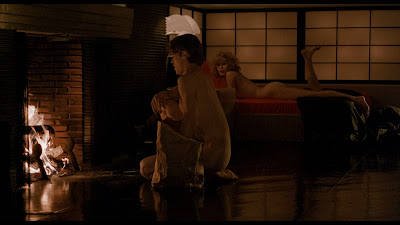
whose partner gets murdered investigating a counter-fitter, played by Dafoe. Dafoe plays an artist who lives in a fancy post-modern home with his nearly naked, exotic dancer girlfriend where he burns his other creations, oil paintings, if he doesn't approve of them. He's some oil-painting sociopath who makes a mean faux greenback.
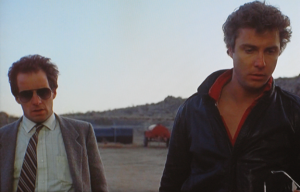
Not much of a villain, but then Petersen isn't much of a hero. He's a protagonist, for sure. He's determined to avenge his partner's murder and he uses his lover/confidential-informant to get information to catch him in a sting, while threatening her to have her probation revoked. Real classy. So he comes off like a scum-bag with contemporary eyes, but then the plot thickens. His determination to catch Dafoe leads him to wrangle his new partner, a young and seemingly-noble John Pankow, best known as Pauly's best friend, Ira, on 'Mad About You'. They can't get enough money from the secret service to make a buy from Dafoe so they decide to hold up a diamond smuggler and ***SPOILER ALERT*** inadvertently kill an FBI agent. The chase following the murder is fantastic and makes the movie worth watching on its own. Pankow starts breaking down and is totally freaking out because not only has his crazy-thrill-junkie partner gotten him to rob a diamond smuggler and use the stolen money to make an unauthorized buy from a counterfeiter but he has murdered an FBI agent. Upon attempting to make the final buy and arrest Dafoe a serious plot twist threw my mind into a tail spin. This twist is actually so good, I won't say any more. I've probably said too much already. You should see the movie. ***

I'm so surprised by this plot twist. I was enjoying the strange world created by the film. It took some suspension of disbelief, but I was enjoying the Wang Chung and Petersen's athletic careening through LA. But the twist made me sit up and pay attention. And then, in a major crisis of traditional plot, a beautiful and glorious scene emerges, full of fire and moral confusion. The film truly captures and relates the Film Noir crisis of moral ambiguity into a universal setting. ***SPOILER ALERT*** Instead of being lured into the darkness by a criminal mastermind or a beautiful, sexy woman, nor by accident or fate, the tragic hero is lured there by an arrogant, confident, handsome epic hero who sweeps poor Pankow up in his scheme for glory, vengeance and just order. And then he is face to face with Dafoe amidst his burning art studio. Engulfed by flames, Dafoe asks Pankow why he didn't try to stop Petersen when he knew it had already gone much too far. 'Because you couldn't turn in your partner.' Pankow is distracted by his moral crisis and the flames leaping about them. and Dafoe beats him to the ground. Just as Dafoe is about to set him on fire with the shredded counterfeit money, Pankow shoots him and he's engulfed by flames.

The film ends with Dafoe's attorney watching home sex movies of Dafoe and his girlfriend. This girlfriend leaves with her new girlfriend, another exotic dancer from the club, played by 'Frasier''s Jane Leeves.
Pankow goes to Petersen's lover's apartment and accuses her of setting them up to kill the FBI agent. He tells her that she's working for him now. She flashes to thinking of sex with Petersen and then cue the Wang Chung and credits rolling over industrial LA at sunset.***

Much of the movie is clumsy and flat, but the plot twist alone makes this well worth watching. The '80s fun cushions the stilted acting, plodding procedural scenes and the totally pointless plot line with Tuturro. Petersen is great fun playing this agent with unrestrained machismo, contrary to his fairly similar role in Michael Mann's 'Manhunter' from the following year.


And while this movie has an interesting moral core, it is still a bit ridiculous with contemporary eyes. The female characters are mannequins roaming about with the lure of sex trailing from their emaciated limbs. They are as relevant to the plot as the furniture. A group of black gangster associates of Dafoes are absurd stereotypes and four of these muscular thugs are defeated in hand-to-hand combat by a painter (Dafoe) and one other white dude in a puffy green army jacket that reminds me of neo-nazis. Stupid. And it's oddly gory. Several people get shot in the head and each time the film cuts to a quick close-up of their head, center screen, with a bullet hole in their face. Kind of fun, but it tells you the maturity level the film is aiming for. Then again, no one is watching this movie to see respectful portrayals of anyone. Watch it for the kitsch and the noir fun of the myth of LA in the '80s.

Saturday, November 6, 2010

500 Days of Summer - % % %


Nestled inside a nifty structure, moving throughout a relationship by days from middle to beginning to end, is a romantic comedy of mediocre and flimsy proportions. Zooey Deschanel and Joseph Gordon-Levitt carry the film admirably, but from the very beginning the narration indicates that this film is filled with crummy people who do stupid things and aren't worth our time. Really. The film tells us that these people suck at the beginning of the movie. Joseph Gordon-Levitt's character Tom is shown in flashback as a child and we are told that he sadly misunderstands love, and then we learn that Deschanel's character, Summer, gets everything more easily in life because she is cute. From the beginning we are told not to trust or respect the main characters. Bleck. Why should we want to watch this movie then?

I have a nit-picky problem with this film as well. According to the film, these characters are two years younger than me. There were no eight-year-olds listening to Joy Division when I was 10. I knew who they were because of my brother, seven years older than I. As I pieced together the time-line of Tom's life, I think this screenplay is 10 years old and no one thought to up-date it. In the intro, we see Tom as a child listening to "bad British pop music" while wearing a Joy Division t-shirt. Joy Division was British, but they were neither pop music nor bad. This is a total mis-characterization of the music. This odd misunderstanding of the music indicates a misunderstanding of the main character. If the screenwriter misunderstands this seemingly autobiographical story, how can the audience be expected to connect with the story?

I did get swept up in the the joyous moments, like the choreographed dance sequence following the consummation of the relationship. And while I enjoy a nicely designed set and costumes, this film went into a nauseatingly heavy-handed cutesy-ness of 60's sharp suits and brunette bangs. Heck, they play house in a set of Ikea furnished rooms, as if their romance is entirely an idealized facade. The film, like the furniture, may look cute at first, but it's made of hollow cardboard and won't hold up. A film like "Singles" is a great example of capturing a style or music scene without overloading the film and crushing what little substance it may contain. Perhaps this has to do with the particular style of the film, rooted in child-like illustrations and clean, sharply-styled 60's fashion. Such a style resists a productive outlet for anger or depression. It is meant to evoke nostalgia, innocence and polish. It's exhausting even midway through the movie.

No one seems to have a sense of humor about themselves either. They are all so serious and sincere. Early on in the film we see Tom smashing plates in his kitchen, devastated at the loss of Summer, who just isn't that into him (no better explanation is ever offered). It's ridiculous but no one laughs at it. His precocious little sister speaks sage wisdom in a monotone to him trying to set him straight. A little laughter might release the intense pressure in Tom to hang on to his crummy relationship. A little levity and humorous self-reflection might endear the audience to the characters. In the end, Tom meets Autumn and starts it all over again. Bleck.

Sunday, March 28, 2010

The Proposal - % % %


I am genuinely stunned by how well executed this film is. I actually enjoyed it.

I am surprised because most romantic comedies are terrible. It's a genre with very clear rules and it's well worn territory. From the screwball comedies of the 30s and 40s to "When Harry Met Sally" in 1989, the genre hasn't changed that much. We know we want an opposed couple drawn together through circumstances out of their control but compelled by their often opposing desires. We want banter. We want charm. We want self-deprecating humor. And we want penetrating contemplative looks at pivotal moments.

If you've seen the trailer, you know that Sandra Bullock is the bitchy tough boss to Ryan Reynold's dutiful, hardworking, enslaved assistant. She is going to be deported and needs to marry him to keep her job as top editor that she has worked so hard for. They go off to tell his family in order to convince the immigration officer of the veracity of their relationship and of course, her cold exterior is broken by the love of a good family and small town in the beautiful wilderness, and he sees that she's actually a very special woman after all.

The Proposal fulfills the obligations of the romantic comedy and exceeded my very low expectations with a thoughtful screenplay and very charming actors. It develops the characters well, but not so much that the film loses its momentum. Betty White is charming and delightful as Ryan Reynold's Gammy, and as always, Reynolds looks amazing without his shirt on. Wow. Very well executed.

What the film lacks is truly real characters that don't rely on generally held preconceptions about certain people and their relationships. Romantic comedies often fall back on these preconceived notions as shorthand for genuine and well developed characters. So the films feel superficial because they are. While the characters are well rounded, the details that indicate their characters never feel finely drawn, unique and textured. We are told that Sandra Bullock's character has a tattoo that represents her dead parents, but the story is that simple. There's no texture to tell us how they died, how she was told, why she choose sparrows to represent her parents. We just hear the story pat and are meant to derive the meaning for the information from what? Other movies we've seen? Our own lives? It's too ambiguous to be truly resonant and powerful. It's why When Harry Met Sally is fantastic, the subtle details telling us so much about the characters and their lives and environments. And it's why The Proposal is well executed but not super. But with the few surprises that The Proposal works with, it's still charming and well made.

By the way, thank you to whomever encouraged Ryan Reynolds to bulk up. I am really grateful. I even watched Amityville Horror just for the two or three scenes with his steaming torso. Shizzle is riCockulous.

Also. mad-props to Sandra Bullock for not being a skinny, tragedy but a slammin, curvy, svelte woman at 45. She doesn't look tortured like Renee Zellweger or Madonna, nor extraordinary like Halle Berry. (But who does?) I have a lot of respect that she never boobed up like Demi Moore. She is beautiful but not tortured or fake. And that in Hollywood, unto itself, may be reason enough for an Oscar. Well, if not that then some kind of lifetime achievement award at least.

PPPS There's a great moment when Bullock gets down on her knees in her tight, posh suit and stacked heels to propose to Reyynolds and because of her proper attire can barely get back up again. I think there need to be more moments of comedic mockery of women's fashion expectations. What competent woman would wear something that immobilizes her so? Ridiculous.

PPPPS Also Oscar Nunez deserves a frickin Golden Globe for his role as Ramone, the Alaskan small town's caterer, general store manager, exotic dancer and marital officiant. His creepy flirtations are fantastic! He brilliantly meanders across the friendly/sexy line wobbling between endearing and skeevy. I love it!

Wednesday, March 17, 2010

Shutter Island - % % %


To start with, this is a film about a US Marshall played by Leonardo DiCaprio who enters a mental asylum for the criminally insane to investigate the disappearance of a prisoner/patient. You immediately know that the obvious plot would be some version of insidious hospital torturing sane patients or an insane narrator. We’ve all seen these movies before. And this doesn’t disappoint by avoiding obvious plot expectations. It disappoints by following them and then flushing them out completely until you are bored and then bored again as everything gets spelled out. I don’t need to ruin the “twist” but you know exactly what it is without me saying anything.

It’s too bad because the first hour of the film is beautiful and haunting. There are striking dream imagery and some genuinely scary moments. But this is the problem. The first half of the film is dramatic and filled with action, sets, interesting characters and complex conversations. It starts as a surreal mystery and then the last hour and a half is several boring conversations. There’s an entire scene of at least five minutes that feels interminable in which DiCaprio has a boring conversation with Patricia Clarkson that consists entirely of cutting between a close-up of him and a close-up of her. Back and forth and back and forth. I’m insulted by how boring it was. And then there are another two or three scenes of conversations that explain one way of looking at things and then explain in words another way and then Ben Kingsley who runs the asylum uses a diagram written on a board to explain something else like it’s a class lecture. If you can’t show it with action, do not spell it out like a lecture. That’s not filmic! That’s boring. They should have known that they were doomed when they couldn’t storyboard that scene any better. It feels like Scorcese just gave up directing half way through and then slapped an ending on top of the boring section that follows through illustrating all the stuff they talked about before. Terrible. Just terrible. DiCaprio is good through all of this and I don’t usually like him. And then the very last scene has another twist. But by then it’s too late and you are begging for it to end. All the visually interesting parts have long since passed you by and you are in reality which is totally dull after the spooky, fascinating and trippy first half. A total let down.

Sunday, December 13, 2009

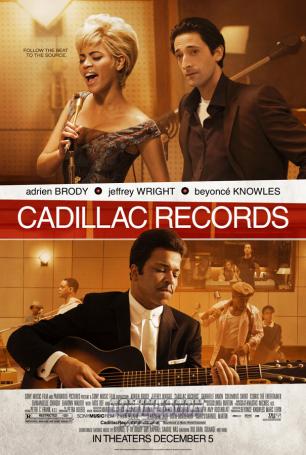
Cadillac Records - % % %


Meh. Nothing special.

and that is a tragedy. I'm glad that millions of people will learn some of the profound history of Chess Records from this film and it has reminded me of some music that I have neglected to purchase. But the deep, powerful, universal themes of the music and lives of the people who built the house of Chess Records are not effectively portrayed by this film. It's there in the screen play and the acting comes close to being affecting. But by encompassing all of the characters from Len Chess to Chuck Berry, no one's story gets told very well.

And I feel that this is a little petty, but Beyoncé should have tried harder to imitate Etta James rather than relying on the vocal techniques that distinguish her own career. It made the second half of the film a modern reinterpretation of the music, and mirrored the challenge facing the original artists as those like the Beach Boys and Elvis delivered paler versions of their work. Beyoncé's versions of James' classics just feel plastic and cheap, like a crappy toy manufactured in China, rather than the original word-carved creation that your grand-dad played with. She does a decent job with the acting but is not believable as a junky. She doesn't gasp the true well of sorrow that James could access in her songs.

Jeffrey Wright knocks another performance out of the park. That man is simply amazing. He is a true chameleon. He is extraordinary in transforming himself into another person so far from his own life in aspect and quality, while at the same time creating an inner world of extreme depth and vastness. I stand amazed by him again.

As for Adrien Brody, he was wonderful in The Pianist, but this is another film that shows what an exception that film is. Perhaps he was not given the material to flesh out or the direction to force him to greater depths, but the depiction of Len Chess felt flat and cursory. This character felt common and too familiar. The hardworking business man who was never home and struggled to maintain success. The moments that evidence the extraordinary character of Chess don't seem to translate into the man himself and feel just like logical indications rather than truthfulness or innate qualities.

All in all, it wasn't a terrible movie. It was competently written and directed by Darnell Martin, a rare female director working in Hollywood. But this film lacks the potent emotion and deeper psychological complexity she has shown herself capable of with her break-out film, I Like It Like That (1994). It seems all of her work in television serials, like Law & Order, has done her great harm as a director since this film suffers greatly from an efficient pace and frugally clean direction.

Saturday, November 21, 2009

Blindness - % % %


While this is an interesting concept, the entire world suffers from a contagious disease that induces a form of blindness, the execution fails at points and the dismal view of the ensuing conflict hits a few false notes. In the end, following how society breaks down is always an interesting exercise and I was engaged until the end.

The main characters are a couple played by Mark Ruffalo and Juliane Moore. Ruffalo plays an optometrist, who the first victim visits for help. Moore plays his wife and from the first scene with them together we are to infer that she is a neglected and shy housewife, and that their marriage is not filled with passion or much warmth. If their relationship had been better developed in the beginning, it might have made the rest of the film more engaging than an exercise in curiosity. Ruffalo does a descent job showing his character's struggles and emotional complexities, but Moore fails to connect with the audience's sympathy as she forges on, bearing enormous responsibilities without any joys or pleasures. She suffers in silence and when she does fall to tears, it has no power, but reminds me of other scenes from Boogie Nights and Magnolia when her tears affected me deeply. Here she feels too distant, drowned out by the extraordinary spectacle of an entire society collapsing around her.

The film is set in an unnamed urban location with unnamed characters. The execution of this is excellent and the feeling of a multicultural metropolis is achieved with remarkable skill by director Fernando Meirelles. Much of the film is in gray tones, and through glass and steel and mirrors, we see the civilization fall apart. Immediately the sick are quarantined in substandard facilities with no staff to attend to the newly blind. They are herded in and abandoned to care for themselves with occaisional deliveries of food. The film gets very dark very quickly. As the hoards of new victims enter the facilities the lack of institutional structure leads to a de-evolution in the small society.
A man (Gael Garcia Bernal) declares himself king and his male dominated wing take control of the food supply. They demand all the valuables from the others in exchange and then they demand the women. The decent into this abhorrent anarchy forces questions into one's mind, attempting to find ways out of this situation. But these means and avenues are not fully explored and the violence is not convincing enough to accept the plot at this point. The consequences do feel natural and a final twist brings the entire situation crumbling to ashes.

At this point the few characters we have come to know form a small family who exit the facility into a totally abandoned and collapsed city. The world has fallen apart and much of the city is abandoned to roaming and staggering groups of the blind. After the first section of the film, the silence and sparseness feels a great relief. What could feel long and drawn out, is a fine easing of the tension into the final resolution. I commend the filmmakers for restraining themselves. In another film, like City of Men, it could be one trauma after another. In Blindness however, the destruction leads to silent scavengering and eventually to the creation of a refuge. The happy ending is earned, although leads this audience member to question the purpose of the exercise in the first place. If it all works out in the end, did the couple and their accompanying new family need to suffer through all of this to find a real appreciation for family? Is that the value in this epic journey? Perhaps if the villains had been better developed psychologically, I might come to feel more confident that loving and caring for one another is the true answer. But since this is based on a Jose Saramago novel, I am not surprised that there is little character development. In this translation into a two hour film, the story might have been aided by a bit more standard psychological development. Saramago can get away with nameless characters because we can enter their heads and read their thoughts slowly over the course of several hundred pages. In a film, a bit more is required to understand how a man can become so cruel and selfish, and if it is that he is simply selfish that makes him cause so much evil, as in Bernal's character.

Tuesday, September 8, 2009

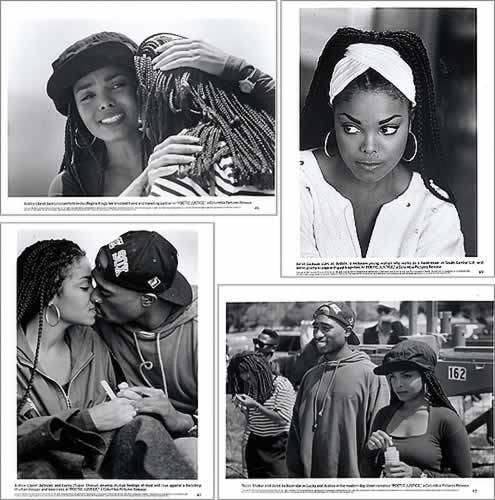
Poetic Justice - % % %


The script is just way too contrived, much like the title. A film about a girl named Justice who writes poetry named Poetic Justice. Ouch. Add to this that the characters are too erratic to feel like real people, let alone anyone you'd want to care about.

Spoiler
The film follows Justice and her friends as they travel from LA to Oakland on a road trip. The film opens as Justice (Janet Jackson) loses her not so great boyfriend (Q Tip) in the very first scene. He gets shot in the head, the blood flying onto her. The scene is typical of the film. The characters simply go back and forth, shouting, kissing, fighting, without much underlying arc. Their personalities and moods simply serve to move the plot along too conveniently. And the plot has ridiculously unnecessary sections like the stop at the carnival. I can see that in editing it was decided to keep the section because it develops the relationship between Justice and Lucky, but it should have been obvious in the screenplay that it felt especially gimmicky after a similar side-story at a family picnic. And then

Justice and her love interest, Lucky (Tupac Shakur), have vulnerable moments, but the rest of the cast are shallow, often heartless and cold. It may be that Singleton wanted to show the various people like this, but it is a harsh statement from a man who knows that he is a rare cinematic voice of the African-American community. Justice's best friend, Iesha (Regina King), and her boyfriend, Chicago (Joe Torry), are particularly juvenile and trifling characters. Regina King has become a fantastic actress, as noticed in Ray. But these characters are ridiculous. Iesha's moment of vulnerability happens quickly. Suddenly after vomiting and being told that her drinking is a problem by her best friend, she comes around and makes a sweeping apology. It's a terrible scene on many fronts. Later she and Chicago break up in a violent fight, instigated by his lack of stamina at sex. It's pathetic for both characters. Is Singleton using these two as a foil for the better love between Lucky and Justice? If so it is too strong a contrast, and they are too awful as people for anyone in the audience to learn any lessons from.

In comparison with his later films, like Baby Boy, I could just chalk this up to youth and immaturity. He was 24 when he made Poetic Justice, so fair enough. That's impressive. There are kernels in the film, especially Janet Jackson and Tupac's performances. They have real chemistry. Justice's character is buoyed by the poetry of Maya Angelou, whose performance and role in the film as a family elder is unfortunately awkward and forced. The film as a whole lacks subtlety and sympathy, let alone a script editor. But there are so damn few films about young black Americans, I'll take what I can get.

Furthermore, I love that it is a respectful story about a postman and a hair-stylist. I think we should revel more often in the stories of more average people. Don't get me wrong that I think film should always reflect reality, but looking at even the indie films of this summer, very few revolve around any people remotely modest or average in their occupations.

Monday, March 9, 2009

Coverfield - % % %


While I did enjoy the film, I think that has more to do with my interest in how filmmakers depict the apocalypse or the destruction of New York, than with the film itself. This is an entertaining destruction of Manhattan. The Statue of Liberty gets decapitated (it's shown on the DVD menu so I'm not spoiling anything) and the Brooklyn Bridge also faces assault. Whole buildings are torn to pieces and Central Park is the site of a gruesome death. So it's entertaining to watch another filmmaker attempt another cover of this modern-day folk song, but aside from the essential interest in the subject and the interesting creature created by the special effects team, the film is pretty terrible.

The acting is awful. The script is offensively stupid. The characters are loathsome and hollow. They are all insipid, 20-somethings living in Manhattan, going to house parties and trying to get it on with other cute and vacant people. The main character holding the video camera through which we view the film is a complete moron and repeatedly says terribly stupid, insensitive things. Why would the screenwriter choose a dufus as our guide? Why would he continue to be so irredeemably dense?
The rest of the characters are flat. Little is developed thematically, except perhaps that love moves people to do foolish things. This theme leads the characters to what is probably the best part of the film.

Semi-Spoiler! The group of survivors from the going-away party that opens the action go in search of the protagonist's love interest. Her apartment is at the top of a high-rise which has been knocked over and leans against a similar building. The group must climb to the top of the stable building and crawl out over the roof of the leaning building. It's a pretty neat idea and interesting to watch being executed.

And the extras are lame. The "alternate endings" are slight edit choices that hardly change the end at all. Weak.

As for the assertion that it is a "screw-you to yuppie New York", the people that it shames for their foolishness and stupidity are the only people we see. They aren't funny and there's nothing ironic. For the film to function, the audience is supposed to identify with the main characters. Otherwise the tension wouldn't exist and no one's interest would be held. So if we are supposed to identify with these characters, the filmmakers think very little of their audience.

Furthermore, in the commentaries and extras, J.J. Abrams, the executive producer, talks at length about his desire to have an American Godzilla. I hardly see much condemnation of the innocent on the ground in this analogy. And as a response to Godzilla, the monster is barely on the screen and cannot be identified until the very end. Godzilla is exciting and captivating because we see the monster clearly and the low-quality of the effects is endearing and entertaining like a cartoon. "Cloverfield" is none of these things. It's a teen thriller/chase movie. It's a video game with obstacles and monsters one must defeat in order to move on and save the golden princess.

So I'd say it's a fun film. Don't expect too much, watch it with a beer and friends, and you won't be too disappointed.

Sunday, February 22, 2009

Beauty Shop - % % %


Attending film school and writing my own scripts has given me a new-found appreciation for mediocre comedy. Comedy is really really hard. Even obvious comedy is hard.

And so I gave Beauty Shop a chance. Everyone can probably guess at the formula for Beauty Shop. Women come together to run a business, meet wonderful men, kick the crappy ones to the curb and look fabulous.

Yup. Queen Latifa stars as the upcoming single mother hairstylist. The film opens with her working under the ridiculous Jorge, marvelously played by Kevin Bacon. And this is one of the best parts of this film. Along with Bacon, Andie MacDowell, Alicia Silverstone, and Mena Suvari, all white actors who usually wouldn't be anywhere near a black-centric film, are included in the film and are very good. Kevin Bacon is great and really creates an absurd yet genuinely funny master stylist, a boy from Nebraska masquerading as a European with kinky highlighted mop hair and a crazy loopy accent.

So perhaps this film is trying to open up the "black" film to a white audience. That might explain why the super hot black male stylist (Bryce Wilson) doesn't get totally smacked down for getting with a white girl, Silverstone. Instead, she proves that she can work it like a black girl and everything is ok. In a more realistic world, the black women would be pissed. I know I would be. There are not enough fine, hard-working black men for all the fine, hard-working black women. Let alone enough for the great number of fine black men who date only white women. That leads to a lot of single black women. I'd be pissed.

Ooh, and the other hottie man-candy is Djimon Hounsou. Shazam! He is so ridiculously beautiful. He has his shirt off only once, which I was surprised by. But you can tell how fine his body is regardless of what he is wearing. I wouldn't say that this is a role in which he shines. He's kind of a blank canvas, meant to be neutrally attractive. His character is made to be widely attractive, and his portrayal is blank for probably the same reason. It's too bad because he is capable of greater depth. I really liked him in the Four Feathers.

Queen Latifa is very good and compelling. She can definitely carry a film like this. She is a little over the top in a few scenes, but is universally lovely throughout and keeps the ball rolling.

So the plot is not the reason to watch this film. It is obvious. Jorge tries to sabotage her, but she holds it together and he gets his comeuppance. And the acting isn't really the reason to watch. There are great side characters, to be sure. Bacon and Sheryl Underwood as Rita the Catfish Lady are great side characters. Silverstone could have been a bit bolder and more confident, instead of wimpy southern-Cher (her character in Clueless). But then her booty-shaking wouldn't have been the surprise that wins over the ladies at the shop.

The reason to watch this film is to spend two hours feeling good about black ladies. When was the last time that happened in your life? It does slip into some stereotypes, which could be precarious for white audiences, but it's cute and simple, as it should be. It's a nice film. And Kevin Bacon is hi-larious. And it gives you quite a few new options if you play Seven Degrees of Kevin Bacon.

As for the director, Billie Woodruff, who previously directed a few pop videos and the Jessica Alba vehicle, Honey (ouch), he does a decent job. I guess I had hoped that when I checked out his IMDB profile that I would find some evidence of his desire to make art. As far as I can tell, he's a workman climbing the Hollywood ladder. Good luck to ya!

Saturday, January 17, 2009

United States of Tara - % % %


I'm impressed by the way this show handles Multiple Personality Disorder in a funny, interesting way. The personalities develop the main character and they act as foils for the other members of the family. But I'm going to reserve my final judgment/endorsement until I see more episodes. It feels a little sit-comy and could get lame after a few episodes.

The daughter is a great character and I'm excited to see where they go with her. The son is funny and sweet as well. Even John Corbett, who can be a tree stump of an actor at times, is actually really good. He had range and utilized his cuteness and charm to good effect.

It's got real potential. I was a little nervous when I saw the trailer for the show in the movie theaters along with Patrick Swaze's new cop show (so sad), but it seems like the writers are working it and can keep it interesting in the future. And obviously Toni Colette is fantastic and amazing. I was never worried about her role in this.

Friday, January 2, 2009

Taxi to the Dark Side - % % %


Well executed summary of the US' history of torture starting in Afghanistan and leading to the policy in Iraq. But I was never engaged emotionally, nor interested philosophically. It's not smug. It's not super partisan. But it's just not much of anything.

There are so many competing documentaries that tell similar stories. I will say that this is a good overview if you want to show it to your sophomore civics class, but otherwise it's pretty boring.

Unlike Standard Operating Procedures, directed by Errol Morris, "Taxi..." encompasses much more than Abu Ghraib. And it includes press conferences and government documents to back up the soldiers' stories about the intentionally poor oversight and regulation of torture. But the interviews aren't compelling. I wasn't affected by any one person because there are many, many interviews, all of which are 2 minutes at the max (I'm guessing, I didn't really measure), and are so intercut with others that it's difficult to make a connection with anyone, even the dead man who this movie follows from his village taxi service in Afghanistan to his murder at Bagram.

Unlike "Why We Fight", this film is limited in its scope and doesn't attempt a philosophical exploration of how we got into this and why, but rather says that the torture on "24" has prepared the US society for accepting torture and gives very little explanation of the motivations of Dick Cheyney and Donald Rumsfeld, other than PR and carelessness.

Taxi... does include an interview with John Yoo, legal adviser to President Bush and author of the "torture memo". He's one slippery cat. He claims that there's no advantage to imprisoning innocent people for years in Guantanamo and so therefore it must not happen. That's some poor logic from a UC Berkeley law professor. I think I'd rather have some added safe guards in place beyond it just not being a good use of resources to imprison and torture people for years with out trial.

Because there isn't enough material to make the story all about the taxi driver, Dilawar (only three photos are used of him that were taken prior to his death), it includes interviews and a short history of the torture policies of the Bush administration. So it starts with a human story with a face and then disappears for an hour into Iraq and Abu Ghraib, all of which has been covered better in other films, and then comes back to Dilawar's death and explains that he was so badly beaten and forced to stand for long periods with no sleep that his legs became, and this is from the coroner's report, "pulpified". Eew. But we don't get to know the soldiers that well, nor the Afghanis and Iraqis. So it's really the equivalent of a poster board presentation. Good information, boring, by the facts delivery.

See Standard Operating Procedures, Iraq in Fragments and My Country, My Country. You'll get the torture, the nation and the people much more than from "Taxi..." and if you want to understand the US government's role, watch Why We Fight and some of the numerous episodes of Frontline available for streaming on their website for free.

I can't believe this film won an Oscar. The best part of it was the title design. But Best Documentary doesn't have a sub-category for Best Graphic Design, so I guess the Academy had to roll-in all together.

Friday, December 19, 2008

Quantum of Solace - % % % - And why I hate movie theaters

I could barely comprehend what was going on in the opening chase scene from the new James Bond film. I was in the fourth row from the back and I still could not see the whole screen. It was so loud I couldn't distinguish sounds within the onslaught.

If I had watched this in my home, the volume would have been more moderate. I would have watched it on a large screen tv or projected on a 15 foot screen and sat at such a distance that the screen would only have taken up two thirds of my vision rather than 150% of it. I also would have been able to eat and drink and whatever in comfortable folding chairs or lounging on a couch.

Instead I lost two years of my hearing and feel traumatized.

I do feel a great loss at the closure of so many theaters and the hard times the industry is experiencing. But bringing in "live recordings" of operas and self-help symposiums is not the way to revitalize the theater industry. But what do I know. I thought those Japanese game shows were the lowest echelon of programming possible, but then I watched a trailer for "Mama's Boys". Clearly reality competition dating shows are lower. And those game shows are joyous and a great use of the temporary nature of tv.

As for the film, it was ok. While it attempted a meditation on revenge which felt weak and a second thought, the action scenes that make up the core of the film were exciting once the initial chase scene ended. The next chase was on foot and I could catch snipits of the architecture and space they were rushing through. But man, it was hard work. How can I be frightened that James Bond is going to crash into the bad guy if I can't comprehend that the rope he's hanging from is attached to a seesawing beam that rotates around the room? With no establishing shot, nor one that lasts more than two seconds, I imagined the plausible hypothesis for what I was seeing and conjecture for what the director might want me to think. Garrgh! Frustrating.

I haven't seen Casino Royale, so maybe the revenge plot might have been more compelling to others.

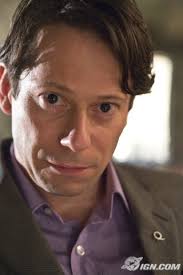
I did like the main plot about an evil multinational organization buying up all the water in the planet and blackmailing developing countries into paying their extreme prices, all under the cover of an environmental organization preserving untouched lands. And Mathieu Almalric is a wonderful bad guy. Why are his eyes so black? They are pools of ink and when he scrunches his face, he transforms into the countenance of demonic possession.

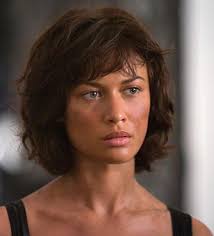
I liked the characterization of the female foil, Camille (Olga Kurylenko). She was tough but with a real justified fear of fire. And another woman gets crude oiled in parallel to the golding in Goldfinger. Really great visual.

I also liked that there were less fashionable but still beautiful locations like Bolivia, Port au Prince etc... and not just Europe and Japan. Or is it that those locations in the global south are now fashionable?

But the fight sequences involved lots of jumping, which reminded even my 69 year old father of the Bourne films. And this from the man who thought, after overhearing a gossipy conversation between my mother and I, that Julia Roberts was a friend of hers from college.

Although I respect the darker, less self-referential direction that the franchise is pursuing, I have never gotten the charm of Daniel Craig. When I first saw him in Tomb Raider, I was confused as to why anyone would cast such a gnarled face opposite Angelina Jolie. Yes, he has clear blue eyes and a certain British charm, and no, one needn't be pristine in order to be attractive, least of all men. But, I don't quite get his "magnetism".

And directed by Marc Forster of Finding Neverland fame? I'm surprised.

Paul Haggis? ack. The screenwriting kiss of weak emotional assumptions of underlying shmaltzy goo. crap.

Why do all the Bond villians have sidekicks with hideous haircuts?

Judi Densch gives my favorite performance of her time in the series, in a role actually written to take advantage of her skill. And I love that the relationship between Bond and M is more closely detailed.

Wiat I just realized that I did see Casino Royale. Ouch. That's a bad sign for the plots of the current phase of the series. Sorry to the writers, but it's true. I had no recollection of the previous film.

There are loads of ridiculous assertions in the film, particularly the action sequences. Bond jumps on a Haitian fishman's shack/boat and can out run inflatable, modern, boats with top of the line engines? Security in these inflatables are using guns and never shoot and deflate their crafts? Bond is so tired by the end of the film that a businessman (Almalric) can almost kick his ass into a firey pit through hand to hand and then axe to hand combat?

I'm just going to steal this next point from Pajiba.com - Ted Boynton: "The Daniel Craig iteration of Bond may not realistically portray espionage, but this depiction has the stones to grapple with the philosophical dilemma of using ultra-competent covert operatives to accomplish what legitimate diplomacy and lawful police work cannot." And this film makes the point, repeatedly, that there are not good and bad guys in international relations, but rather governmental/military entities who serve the economic interests of their tax paying corporations (the corporatocracy).