Showing posts with label % % % %. Show all posts

Monday, May 23, 2011

You Can't Take It With You (1938) - % % % %


This is by far my favorite film by Frank Capra.

I would love to live in the zany Vanderhof household. Headed by a heartfelt, contrarian grandfather, played by Lionel Barrymore, the home is filled with dancing, cheering and firework experimentation. Everyone does whatever they want to have fun. It's delightful.

For some reason the naivety that grounds all Capra films bothers me far less in this film than in his others. I'm usually disgusted by the sappy, non-judgemental and non-analytical approach of Capra's films. Perhaps because this film is based on an already established play, Capra's hand in the storyline is limited.

And yet, watching this film in my 30s and in 2011, I am bothered by several issues in this film that I don't recall when I first viewed it at the age of 20. Why does this cheerful family, in which everyone does what they want, have servants? Rheba, played by Lillian Yarbo, sure seems like a member of the family and she seems pretty happy, but she's still seemingly a cook and maid. It feels odd through modern eyes for this egalitarian family to have a black maid. She is a great dancer, though.


I am also troubled by the simplistic resolution of the father-son conflict. I suppose I shouldn't hope for more dynamic and fulfilling resolution, rather than the pair of looks and smiles we are offered. Everyone forgives the evil, nasty banker who destroyed lives and cruelly proclaimed his superiority over all those unfortunate to be poorer than he. Having decried him in court a week earlier, everyone hugs him now that he's remorseful and playing a harmonica with grandpa. I get that this particular family is very open and forgiving, but it still feels like a bit of a stretch. And I suppose I have found the Capra naivety that I may have over looked in previous viewings. It's still my favorite Capra film, but in my opinion the bar is set pretty low. There are moments of sincere humanitarianism and great screwball comedy in his films, but these are drowned in the sappy, marshmallow gooeyness of the superficial resolutions and impossible Pollyannaism overall.

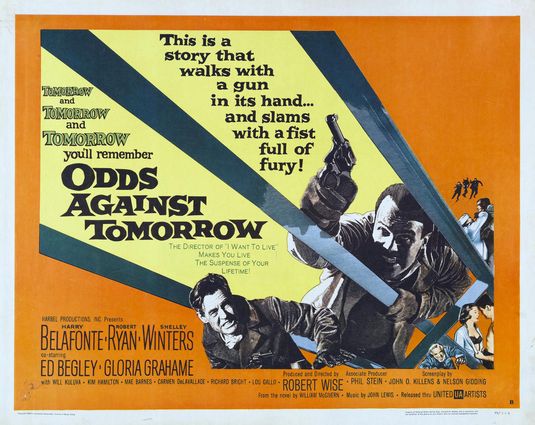
Odds Against Tomorrow (1959) - % % % %


Most noted for Harry Belafonte's role as a gambling addict, "Odds Against Tomorrow" is the first film noir to feature an African-American in a primary role. It is also a bleak film of failed lives overwhelmed by tension and fear, followed by rage. Produced by Belafonte's production company, the despairingly titled film works to give a context to racial tensions through the pitiable and harrowing lives contained by this heist flic.

The fascinating set of characters, mean and desperate, draw in the audience with their treacherous attempts at easing their struggles.

Robert Ryan costars as Earl Slater, a white ex-con with a chip on his shoulder and a temper to follow. He chafes at his inability to improve his lot or to avoid violence, ricocheting from bar fight to the door of his pretty, married neighbor, whom he degrades, manipulates and forcefully seduces.

As is often the case with films spearheaded by actors, the character development is primary to the script, and the action begins nearly halfway through the film, as Slater finally commits to a burglary scheme. Then he confronts his new partner, Belafonte, who is also desperate to cash in on the job to pay off his thug creditors from the race track. Slater's racism steams through his eyes and words, and the tension between the two is terrifying. There is no high ground. There is no noble character to raise the situation up to unify the two and bring them together. Instead, these troubled men are thrust together and head off to the heist. "It's gonna let us live again."

Best known for directing musicals like West Side Story as well as The Day The Earth Stood Still, director Robert Wise gives New York a harsh, frigid atmosphere. Bare trees and bitter winds penetrate the scenes, causing the actors to brace themselves against the world. Rather than filling this underworld with inky shadows, low angles peer up at the many shades of gray in this morally unhinged arena. Positioning the camera low to the ground, gives the impression of a towering weight about to fall on the characters at any moment. They appear isolated and imbalanced. Out on the streets, buildings loom up in the darkness; the sky is completely out of sight.
For a film about race and social issues, it holds up surprisingly well to this set of contemporary eyes. The score, although occasionally distracting, serves to layer anxiety and 50's jazz strains and intrigue. The conclusion gives the film the feeling of a morality tale, distracting from the potent tension created by these two actors. If the ending had only retained the seething interactions which engage the audience the most, this would have been a far more satisfying film.

Monday, December 13, 2010

Black Swan - % % % %


Startling and hallucinatory, Black Swan is a psychological horror story. Nina, played with every muscle by Nathalie Portman, achieves her lifelong dream of playing the Swan Queen in her ballet company's production of Swan Lake. Nina is a fragile perfectionist dominated by her live-in mother, a former dancer herself. Nina is already fraying at the edges from the physical pressures of professional ballet, so the elevation to her new role and the challenges, amplified by her director's sexual manipulations, lead her down the rabbit hole.

To succeed, we are told, one must give everything of themselves with abandon. Be free in the full sacrifice to one's craft. The greatest artists, athletes, whatever one admires, completely immerse themselves in their passion and are dedicated to perfection, n'est-ce pas? Nina releases her ego and identity in the complete submission of herself in the role of prima ballerina and she dissolves.

Directed by Darren Aronofsky, the film excels in this dissolution of reality. No other director achieves such a tangible, empathetic form of fear and nausea at the destruction of the human body. I left the theater after seeing Requiem for a Dream, thankful for my arms and for never having been so desperate or tragic in my life to succumb to prostitution. "Black Swan" makes me so grateful for the solidity of my body and my fingers and my bones and the entire thing. He achieves a rare squeamish terror that directors of Saw films should envy.


Furthermore, the disorientation of the climax and finale is complete and unpredictable. Unlike a film such as "Shutter Island", there are no explanations drawn out for the audience. The events swirl around Nina like the hallucinations they are. I've never seen such an accurate portrayal of the effects of Ecstasy on film. That alone is quite impressive. Nina's identity refracts like shattered mirrors as her self becomes her only real human connection and as she disintegrates into her new role.

Her body, her ultimate tool, rejects her and transforms itself, or perhaps she unconsciously transforms herself. Like a neurotic twitch that one cannot restrain, her skin and fingers and blood begin to alter against her will. A ballerina must be a master of her body, and her bulimia enables an illusion of physical and psychological control.

She is fragile and pale, like an egg, and as the pressure increases she cracks in a messy, messy way. It's exhilarating and spectacular and queasy and actually scary.

The casting is fantastic with the former prima, whom Nina replaces, played by Winona Ryder, and the new challenger played by Mila Kunis, who I am delighted to see in a drama. She is fantastic and utilizes her charisma to seduce with danger, rather than self-deprecating humor. The director of the company is slyly portrayed by Vincent Cassel using his sexuality and authority to embody that special kind of manipulative, seductive machismo. Rounding out the cast is Deborah Winger as the mother. She is quite terrifying yet believable. She resists the caricature of the failed mother living through her daughter and deftly plays the mind games of the most brilliant passive-aggressive matriarchs. Nathalie Portman deserves award considerations. She carries the film. Her character is nearly hysterical through the whole film yet she never becomes shrill or irritating. At the open of the film, I was saddened that such a good actress should immediately call to mind the stilted dialogue of Padme from Star Wars. To my relief she obliterated that character from my mind with her passion in this new role.

I will say as a draw back that the sound effects, while effective, were occaisionally over done and comical at first. Such a hallucinatory film is difficult for an audience to transition into at first and the sound effects just felt goofy for the first quarter of the film. Even towards the end, I found them heavy handed.

The pacing of the film was excellent and reminded me of the great psychological thrillers of Hitchcock. I am extremely impressed and thrilled that Aronofsky has returned to such dream-like territory. He is, in my opinion, at his best and most unique when creating a whirl-wind of the mind. His dryer character drama, "The Wrestler" was epic and poignant. But it lacked the joy and magic of creation that Aronofsky holds. If you are capable of extraordinary flights of fantasy, I'm not sure why you would ever tell such a miserable story, no matter how well told or illuminating it is. It'd be like Terry Gilliam directing Erin Brockovich. Why? And I think The Wrestler was a fantastic story of great depth and interest. I'm just so thrilled to get more from Aronofsky's imagination.

There is so much more I could say about the body manipulation inherent in such religious ferocity and the self-destructive commitment to success and work as a form of enslavement. What is success for? Is anyone really remembered in our ADD society? Are professional athletes any different than this woman crushing her toes to be beautiful? Is the drive for success always based in a lack of self-confidence and a frailty of identity?

Awesome. Scary. Trippy. Cool.

Wednesday, March 17, 2010

Green Zone - % % % %


Green Zone is the latest film by Paul Greengrass, best known for the Bourne films, but also the filmmaker who created United 93, a suspenseful, dread-filled docu-drama. Green Zone is a combination of these two styles – a tension filled spy action film crossed with a political historical drama. As king of the low-light shakey cam, Greengrass pulls off a twisting turning suspense with incredible shots of helicopters and a taut military procedural plot. But as a historical political film, it indicts the Pentagon and makes the CIA look like noble handlers of the world. Matt Damon’s character, Chief Miller, has just landed in Iraq in March 2003 and leads a team to investigate suspected and empty locations for WMDs. He begins to question the Pentagon intelligence and this leads him on a chase through Baghdad with his new friend, Freddy, played by Khalid Abdalla, from the Kite Runner. As a military procedural it is exciting like Black Hawk Down. But as a drama, it misses. By exciting the audience with semi-accurate portrayals of historical events, almost like a dramatized episode of Frontline, it fails by being a fictionalized account of a very serious issue, the fabrication and falsification of the reasons for the invasion of Iraq. I agree with the sentiments expressed in the film that the American public was lied to and failed by our government officials and the press, but by fictionalizing and generalizing a subject of such massive importance, Greengrass dulls his blade. Matt Damon, who has no character other than wanting the truth and doing his job well, gets to shout condemning statements at the Pentagon official played by Greg Kinnear, but it’s truly pointless with our knowledge of the quagmire that is to come. That is one thing that Green Zone does get right. It ends with a devastatingly defeated feeling that many of us feel about Iraq. It’s a disaster and there’s so little that we can do about it. The come-uppance at the end can’t be satisfying because it’s so tragic.

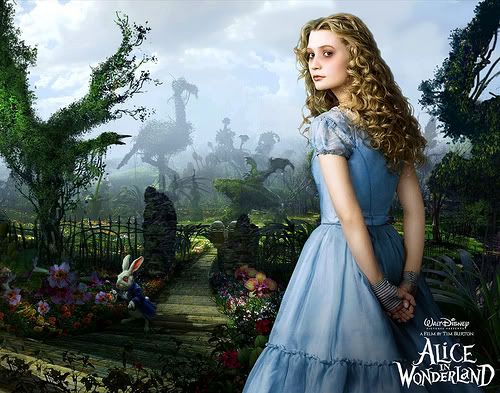
Alice in Wonderland - % % % %


Alice in Wonderland is the perfect project for morose, quirky director, Tim Burton. The scraggly trees and fog that greet Alice upon arrival in Wonderland are straight from his repertoire, such as Sleepy Hollow or The Corpse Bride. But along with the shadowy darkness and child-like fascination with death, there is the beauty and charm of the fanciful and vibrant world created by Lewis Carol. And Burton develops this fantasy in beautiful fashion. In Wonderland fire is not just flame colored, it’s got sharp bursts of pink electricity.

Again we have the team of Burton and Johnny Depp, in crazy teeth with a variable accent that jumps around the British Isles according to his mood and eyes that change color accordingly like a mood ring. I am stunned by how many crazy-drunk voices he can create and still establish a unique character.

This is not the usual story of Alice, which is brilliant since we all know the original and it would be difficult to keep the film suspenseful or interesting if one simply followed the book. Instead we meet Alice as a young adult about to be trapped into a marriage with a sniffling wimp. She disappears down the rabbit hole again and discovers that she is not a heroine any longer, because she isn’t much like a hero. She has lost her muchness. This film follows her gaining confidence and muchness through rescuing the Mad Hatter and others and standing up to the Red Queen. The plot is weak in this part and the devices that serve to strengthen Alice are not as innovative or moving as the visual creativity on display in every nook and cranny of the film.

I’m totally impressed by Burton’s creation of a scary fantasy world of beheadings and madness that never becomes too scary for kids or too lame for anyone. The macabre cruelty of the Red Queen is enhanced by the tortured birds carrying her chandelier or the monkey butlers holding up her chairs and tables. And who doesn’t want monkey butlers? Awesome.

In fact one of the most child-like aspects of the film is the deep love of animals from the affection of the delightful monkeys and frogs in the Red Queen’s service to the hound dog who saves Alice and the grizzly Bandersnatch whom Alice befriends. It’s sweet without being bubblegum and it fits so well into a story in which animals are both deceitful and mad, as well as the oracles to wisdom.


It’s really good and although the plot could be more inventive, I think it’s Burton’s best film in years.

Monday, February 15, 2010

The Hurt Locker - % % % %

Why am I not CRAZY over this film? It's wonderfully crafted. The action and scenario are interesting. The characters are well developed. But I think I don't feel moved by them. The acting is very good and they follow revealing lines and interrelations. I really really like it, but... I can't give it 5 percent signs. Too bad.

In the commentary, director Kathryn Bigelow talks about how she felt that the war was under-reported. I think she explains it in a new way. I have been looking to long form documentaries to tell me the stories I want to know or am curious to see. I want to understand more complex aspects than can be told through a 500 word article in a newspaper. I want to understand the war in broad strokes. The small portions that happen in a few hours or in a day are the stories of military movements and deaths. In "The Hurt Locker" we finally get to see the work-relationships and the missions and how the war is being waged. It's fascinating and a great credit to the screenwriter, Mark Boal, who spent time imbedded with a bomb disposal unit in Baghdad.

I'm super happy to see David Morse in a small part. He's always so great. His pudgy eyes belie the deepest sorrows of Saint Elsewhere.

I wonder if it's because I watched it at home. I bet if I had watched this on a big screen, I'd have been as terrified as during "Black Hawk Down", the scariest movie I've ever seen.

Saturday, September 19, 2009

Il ya longtemps que je t'aime (I've Loved You So Long) - % % % %


A brilliant concept for a character-driven drama, Kristen Scott Thomas plays Juliette who moves in with her sister's family after 15 years in prison for murder. Her sentence comes out pretty early in the film, so I don't think I'm ruining anything by telling you that she killed her son when he was six. It's a remarkable story of the struggles of resiliency. How does one go on after something so horrible and then after losing so much of one's life in such a shameful and impossible to understand manner?

Kristen Scott Thomas is excellent. Really excellent. Her eyes hold a well of sadness known particularly to those who have lost their children.

The script is excellently written and directed by Phillipe Claudel, including paralleling stories and characters that broaden the main plot and elaborate upon Juliette's journey. She is befriended by her parole officer who suffers from his own demons. Her sister, well played by Elsa Zylberstein, has two young daughters of her own whose mere presence continually emphasizes the conflict and develops opportunities for inter-character conflicts. She has chosen to adopt because of her fears after her sister's actions. It is profound how our actions lead to the understanding of our younger family members' worldviews and this is a deftly woven example. As Juliette is developed, set pieces illustrate and remind the audience of her struggles, from wheelchair bound extras to the new birth of a friend's child. Again and again, she must revisit how her life will always be different and similar to others. It's magnificent at times.

And yet, there are moments that are too heavy handed. A friend tells her that he doesn't judge her because he worked in a prison once and has learned that we, the free and the convicted, are all the same. Oh, brother. It's already clear after explaining that he worked in a prison for a time, but he goes on and explains it all so unnecessarily. It's too bad because it's otherwise a wonderfully tender and hopeful moment. There are others included in the film and still more in the extras' deleted scenes. I wish they had cut just a little bit more. The film could have soared even higher.

All in all it's very very good. I put off watching it because I thought it'd be too depressing and, while there is a deep sadness to it, the film is extremely hopeful. This is not misery-porn like Cherrie Baby or some Lars Von Trier sadistic parade of emotional torture. Kristen Scott Thomas' reserve becomes a force of strength and hope and the surrounding cast is a crew of some of the best people one could ever hope to know. Perhaps a bit too optimistic, but there are plenty of judgmental side characters for balance. It never feels too cheerful. It is true that spending an evening with a bunch of kids running around a beautiful home and walking around a vineyard with a bunch of intelligent friends is wonderful and it does regulate the dreariness of life. This is a character who, like her social worker and parole officer say, is very lucky to have family. And through these thoughtful adult relationships and the bonds of communal, daily, family living, a very wounded soul can be a resource of love and support as well. And maybe live happily ever after too. Well, can live ever after, which is often the best we can reasonably hope for, and that's OK too.

Wednesday, January 7, 2009

Hellboy II - % % % %


Better than the first!

I liked the first one a bit. But it was lacking more developed characters. But the plot was interesting, as it related to the creation story of Hellboy and involved paranormal-obsessed Nazis.

If you haven't seen the first, don't watch the second. The characters will be even less well developed for you. Selma Blair is back as a temperamental fire-starter now living with Hellboy, a nearly indestructible being from hell, a parallel universe-type-thing, where he is the prince. He's got a giant stone hand that smashes stuff, a pointy tail, red skin and two horns the grow out of his forehead but which he sands down every day so that he can blend in more with humans. And he loves cigars and shooting at stuff.

In this installment an elf prince is fed up with humans ruling the world because we have holes in our hearts that can never be filled no matter what we possess, but we keep on trying! So he goes on a quest to capture all of the pieces of a crown that controls an indestructible golden machine army that can easily destroy all of humanity. And we're off.


This installment benefits from an increased budget and Guillermo Del Toro's experience filming Pan's Labyrinth. His style is more developed and there are loads of very unnerving trolls and demons dwelling in extraordinary sets. The final battle is set amongst gigantic wheels like in a clock. It's incredible and must have been so much fun to build.

So it's fun if you like comics and sci fi. If not, you're not missing much by skipping these.

Monday, January 5, 2009

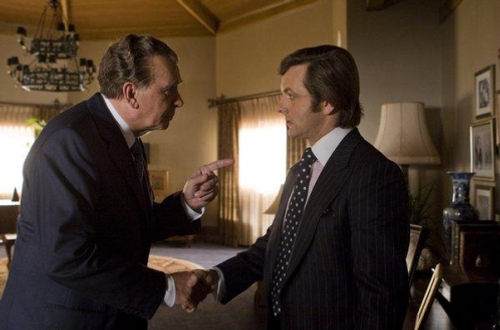
Frost/Nixon - % % % %


Great, superb, outstanding acting. I know mimicry is different from acting, but combining both together is pretty impressive.

I'm stunned that the same actor, Michael Sheen, who lulled me into believing he was Tony Blair got me to believe he was swinging, talk show host, David Frost.

And Frank Langella is outstanding as Nixon. I thought that Anthony Hopkins did a good job, but in comparison he was obscenely over the top. Langella is subtle, reserved, aged, and he still makes the gestures and the face work.

The downfall of this film is that no one is likable. Frost comes together for the final act and Nixon breaks his steely surface, but so what? I don't care for anyone. Sheen's performance got a little repetitive, using shifty eyes and a fake smile to show the cracks in Frost's confidence. And he over does it when he shows how bored or incompetent he is while interviewing Nixon. And who is his girlfriend? She feels like a real person, but I know nothing about her.

The researchers, played by Sam Rockwell and Oliver Platt, are great! Sam Rockwell's character hates Nixon and has written four books on his crooked administration. I did feel joy when he gets the admission of guilt he desired from Nixon. And I'm so glad that there was a character who served the purpose of explaining all of the atrocities of the administration. Oliver Platt is kinda always the same guy, but I like him so much that I don't mind. Matthew MacFadyen appears as the level headed producer of this show that almost wasn't, and his reaction to their success is delightful.

All in all, I felt like Ron Howard did a good job. There were definitely many changes made in adapting the play to the screen that worked very well. It must be pretty challenging making two people talking to each other visually interesting. I particularly found the compositions including both the actual person and the monitor showing the video feed of their face to create a splitting of attention that made me question what I wanted to watch. Did I want to see the real face or did I want to see what the audience at home would have watched?

I have to say that the last 8 years were brought to mind several times, particularly when Nixon defined presidential powers and the legality of any action taken by the president. If the president can do anything and be above the law, then he or she is a temporary king or queen. And if you can use signing statements that gut laws or add new parts in, like our current president, the transformation from democratic leader to despot is nearly complete. Ack! When will we learn? Will it change on January 20th? Fingers crossed.

Saturday, January 3, 2009

Shut Up & Sing - % % % %


So I gave this doc 4%s for surprising me. It's a well told story of real conflicts in a set of adult women's lives. I didn't end up admiring the Dixie Chicks, in fact I'm sad that they were so wishy-washy, and apologetic when the controversy started. And they never really said anything too firmly. But the story of the group finding themselves as musicians and mature women was interesting to watch.

The film jumps back and forth between 2003 and 2005/6. In 2003 on the eve of the invasion of Iraq, while playing a gig in London, the lead singer, Natalie Bains, said that she was with the audience, on "the good side", probably meaning that she was with the enormous anti-war protests occurring in London at the time. And she wrapped up by saying that they were ashamed that the president is from Texas.

That first tour shows the Dixie Chicks dressed up in trendy semi-punk fashion and working with a corporate sponsor for their tour, Lipton. They start out as total commercial material and through the controversy, lose their fan base. They realize that many of their fans were very fickle and extremely judgmental. As time goes by and the controversy doesn't ease, it frees them as a group from their commercial limitations as are attached to the country music market. Country radio stations won't play them because of a grass-roots boycott by an extreme right nationalist group.

This rejection fuels them creatively and for the first time ever, they write (nearly) all of the songs on their new album, in 2005. The music isn't my taste, but it's moving to see women really express their feelings and experiences through music. Their maturity, confidence and strength are exciting and push them forward into making more interesting and less common music. And as they mount their next tour, they dress like adult women. No more fake punk skirts and bizarre makeup. It's still heavy fashion, but it's more sophisticated and subdued. And they are all mothers at this point. They have families and have been through a rough patch and came out stronger and more independent. They begin to say, screw the record company, screw the financial instability. We believe in ourselves and our music. They take a greater ownership and seem to be more involved in their music. It's a great transformation to see.

It's not going to revolutionize anything, but it's quality. It didn't change my worldview or leave me in tears. But I think it is a telling statement of the US and traditional country culture that they could toss out these fine musicians so fast and support an ignorant ass like Toby Keith for bashing the Dixie Chicks. Bleck. He comes off as simple minded and as an opportunistic reactionary thug. So I say good luck, Dixie Chicks! I hope their new found freedom enables them to pursue their lives and their music into new directions.

Friday, January 2, 2009

Surfwise - % % % %


Ah the Paskowitz family. "The First Family of Surfing"

Surfwise introduces each parent and child, all 9 of them - 8 boys and one girl. They are each interesting characters, mainly resulting from father, Dorian, and his egoistic, semi-cult leader persona. Dorian decided to raise his children by piling them into a camper and traveling the world surfing. His wife, Juliette, remains enthralled with him as a passionate idealist.

The children, now all adults, have varying degrees of enthusiasm about their upbringing. The film, directed by Doug Pray, concedes to the fantasy for the first part of the film, depicting the sun-tanned, lean, wild, surfing children and their quirky father's ideas of how to raise a family. Dorian at one point shouts that he wanted to be as good a father as a gorilla. So if a gorilla breast fed until the baby was two, that's what they would do. He seems to have taken bits of information from many places and latched on to a father knows best mentality.

The rules of the family, including morning calisthenics, all sleeping in a small camper together even though the parents had sex every night in ear shot of the kids, surfing every morning, eating seven grain cereal, etc... sound very 60s cultish. But much of it is appealing.

The siblings all clearly love each other and family is very important to them all. But as the film progresses, the usual cracks appear in family dynamics. The children resent the father's authority, particularly since he was an absolute dictator. The eldest child takes on a fatherly position and the other brothers resent him and compete amongst themselves, especially in surfing competitions. They were so poor that they didn't all have clothes. Many went shirtless at times. They all express regrets about their lack of formal education. None of them ever attended school, and now as adults have a difficult time reintegrating into society.

The film is lovely, incorporating interviews with this very beautiful family, old family photos, and film of them surfing. It is captivating to see such vibrant children and the ocean's eruptive waves. Clearly surfing is a lot of fun.

It's a great documentary that shows a rounded depiction, with an ambiguous perspective, of a unique family of interesting characters. It explores issues of familial loyalty, best parenting practices, consumerism, hindsight, health and love. All with a gorgeous background of beaches and tanned skin. It's a fun watch.

Thursday, January 1, 2009

Inheritance - % % % %

A very troubling documentary about the fallout of trauma for both the survivor and the perpetrator's offspring, "Inheritance" introduces us to Monika, daughter of Amon Goeth, Nazi concentration camp leader and vicious murderer, who was played by Ralph Feinnes in Schindler's List. Monika's life has been haunted by the sympathizers, like her mother, who hid the truth from her and taught her their own kind of hatefulness, and the growing realizations of from whom she came. She is a sad person, whose shoulders slouch and whose hair falls in her face, attempting to conceal the shame and fear she bears.

Monika contacts Helen, a survivor of the camp who worked in Goeth's home as a servant, who now lives in New Jersey with her three adult children. They arrange to meet to provide information and closure for each other.

But while Helen is able to come to a greater sense of personal closure through the trip, Monika remains thoroughly shattered by the shadow of her father's brutality. She is so shamed to have come from such a monster and so afraid of becoming him, that she willingly tortures herself by meeting with one of his surviving victims and visiting the actual location of the brutality.

This film revisits one my current themes: children filter the trauma of their parents. If we are all fortunate to live lives without further trauma, perhaps we can come to a greater society. Until then, the tortures and miseries of previous generations will be worked out by their children, who are better capable of seeing their parents' ills, but will necessarily inherit and absorb some of them.

And so Helen, who survived such horrors, has made a kind of peace with herself, but the somewhat younger Monika has been handed the full weight of her father's sins without anyone to help her comprehend their ramifications. She is crippled by her upbringing and the realization that her father was a monster. There is a mention early on that Monika and her husband are raising their grandson because their daughter has a drug problem. It seems to me like so many children are burdened with things they were not present for, but whose results profoundly affect their approach to life, and they are unable to cope. So perhaps Monika's grandson will find a healthier state of mind.

The film was so uncomfortable with Monika's sorrow, but I came away with a pondering question. How can we help each other heal? Monika expresses fear that Helen's daughter will look at her with hate, and she also recognizes the terror in Helen's eyes when she discusses Amon. Can the next generations assist the previous? How can one face such circumstances, or accidents of birth?

It's so sad how much we desire to know our parents, as if we can get a firm grasp on ourselves through understanding them, and as if we could gain control or power over them by understanding them better. Monika's desire to know and understand her father seems to hold a need to be loved and I suspect she hopes that she might meet someone who might one day tell her something good.

The two moments of greatest tension between Monika and Helen point to some of the greatest fears present in our social unconscious. Helen becomes overwhelmed by the power of Monika's feelings and she must walk away to protect her own fragile feelings. And later, Helen makes it clear that she cannot even hear the lies that Monika was told. While Monika wants to express the change between her and her parents' generation to gain appreciation from Helen, Helen simply cannot accept a discussion of the lies because it is so offensive to her. Other peoples' experiences can be so upsetting whether because of empathy and/or because of our ego-centric perspectives on their experiences. What does it mean for me?

Reason # 594985 that film is important:
In a post-screening interview, Helen says that "Schindler's List" made it possible to discuss the horrors of the Holocaust with family members and strangers. By having a reference point, others became more able to understand, and after becoming engaged by the film others have more of a desire to understand the experiences.

Sunday, September 9, 2007

INLAND EMPIRE % % % %

Baffling, as always, this is Lynch at his most unrestrained. Working without a completed script and in digital video, David Lynch bounds through various themes: Hollywood, violence, sex, interconnected times, mysteries of the night, suburban secrets, 50s pop culture, and just anything that might creep out a viewer. There's strobe lights at uneven paces, screams, blood red lighting effects, decay, alter-egos, doors through time and space, demented women running at the camera into a close-up and more awkward closeups. And more closeups. The light digital cameras enable super-close shots at slightly odd angles, and Lynch utilizes the most irritating of digital camera mistakes to his unique motives. He manipulates focus so that the background is in focus when the face in close-up is out of focus, contrary to expectations. It's a little unnerving, and suggests that no one is ever clearly known.

Following an introductory scene involving a couple enterring a hotel room, presumably a sexual/business relationship, in which both people's faces are blurred, the first hour or so is fairly linear, and surrounds Laura Dern's character, Nancy, an actress in Hollywood, married to a powerful and mysterious man. She meets her new neighbor, played by a standard Lynch actress, who is super weird and says that she cannot tell tomorrow from yesterday. She also tells an odd story about a boy who goes out to play and creates evil. Evil. Evil. It doesn't make sense at the time, and I kept hoping it would click with something else in the film, but I got nothing out of it. Nancy gets a new film role and the linear plot follows the making of the film, which concerns a couple who enter into an adulterous affair. Nancy begins to lose control over the difference between her life and the film, and this is where is all goes bananas.

Nancy goes through a metal door off of an alley, goes back in time to an earlier scene and then gets trapped in a fifties-ish coral living room. She explores the house and spends most of her time with a group of young women, sexually provocative and dimly lit. There's screaming and red lights, bright flashes and choreographed dancing to 50s pop songs. The film moves to Poland, where Nancy's husband is involved with an invisible woman and some old men. And then Dern, dirty and dishelveled, meets with a man in a dark room high in a dilapadated warehouse, where she discusses her past abusive relationships and the ways she's beaten the men she's escaped from. There's also a side-line involving Julia Ormond, who I haven't seen work in a while, who goes into a police station. She's disturbed and has been hypnotised by some man in a bar and told to stab someone with a screw driver, but she's already stabbed herself with it. Then later she reappears as the wife of the adulterer in Nancy's film, and again as the first crazy version, stalking dirty Dern on Hollywood Blvd. Here the young women from the house are now prostitutes but still snapping in time together. Dern gets stabbed, staggers past the stars on the boulevard and collapses next to some people sleeping on the street waiting for a bus to Pomona. Not to mention the interludes of sitcom style scenes about a family of rabbits who speak in odd sequiters, as if part of an absurdist play.

There's all sorts that I've left out. Some of which I can't recall because it didn't make sense to me and some of which, like the Beck song on the soundtrack and the burlesque club, that felt awkward to me because of their contemporary connections. It felt to me that there was too much freedom. It went on too long and in so many different directions. And the film retread a great many of Lynch's themes that it at times felt like a satire.

So I found it an interesting freak out, but it lacked the mysterious beauty of films like Blue Velvet and Mulholland Drive, and the cohesive feeling of purpose of Lost Highway. I thought a few times around the two hour mark, that I would never indulge another filmmaker like I would Lynch, and with good reason. The dirty Dern was truly creepy, and the strange hallways leading to other places captured that archetypal mysterious feeling found in everyone's unconscious that brings me back to Lynch again and again.

Friday, August 31, 2007

Dexter % % % %


I'm still not totally sold.


But it's well written, acted and directed. Michael C. Hall is great. I love everyone from Six Feet Under so much, that sometimes, I miss them. Like old friends, I miss them. It's pathetic, but damn those were some well written characters. The writing got a little wobbly towards the end. But damn. I loved that show. I cried when it ended because it was over. And because the ending broke my heart. I still get wistful thinking about Keith.

So, my SFU aside aside, I think the writing on Dexter is great too. And it's totally quality visually. But... I don't know if I care yet. I don't know if I care about the characters. And really this is the challenge of a show about a likeable serial killer. So we'll see. I'm not totally convinced yet, but I do like the progressions of the characters that I've seen thus far. And it is a fascinating conceit that anyone would have a parent who loves them so much, that regardless of one's inclinations, habits or compulsions, that a parent might still help them to fit into society. I'm sure most parents like to think that they adjusted their parenting to the people that their kids presented as, but I think it's far more likely that most parents try their damnedest to make you fit their idea of you. Which, perhaps is really what happened to Dexter. And it is this conundrum that is drawing me on.

Keep up the good writing and I'll keep watching. And maybe I'll change my review to 5 %s.

Monday, August 27, 2007

Zodiac - % % % %

Following a set of characters of varying connection with the Zodiac murders over a period of 25 years is a tall task. Like biopics, true life historical films are tricky. Real life is just too random, boring, disconnected and NON NARRATIVE. It doesn't fit the stories we like to tell, because inherently the stories we like make us feel better about our lives by implying that there's order or meaning or resolution, when really there's very little of any of that. So I'm pretty impressed by the way that Zodiac creates a traditional emotional narrative arc out of material without any peak in action, aside from the murders that start everything, and a notoriously poor resolution. Just to let the cat out of the bag, no one is every arrested for the murders. Nor does anyone know for sure which murders should really be attributed to the Zodiac killer.

By focusing on the author of the true crime book on the Zodiac case, played by Jake Gyllenhaal in an earnest but childishly naive and foppish manner, the screenwriter garners the viewers' sympathy. We, like Gyllenhaal, are intrigued, fascinated by the seeming randomness of the killings, and perplexed by the letters and puzzles. But the middle of the film focuses on the actual police work, spread out over many years. The lead to the likely killer and his character development isn't exciting. The actor isn't creepy in a Hannibal Lector way, nor is he terrifying in a suspicious or secretive manner. He's just weird. And his trailer full of squirrels isn't as scary as it should be. Squirrels are crazy when trapped inside. They scrape up the walls and tear down curtains. They just weren't scary enough.

So all we're left with is the itch. And Jake the cutie. And he pushes his family away. And I could see what he was doing and that it was bad, but I didn't care. Chloe Sevigne was so mousy she was empty. So I didn't care that she left. I was glad that she took her sour face out of the film. His kids are cute, but I figured they understood, and it seems so, since they enjoy helping their dad with clues in the case.

But I will admit that the filmmakers made the climax and resolution work. They pulled it essentially out of thin air, but emotionally it was good. Jake follows a lead to a creepy house and I was sure terrified. Now that guy was creepy and ominous and threatening. And of course the basement was scary and there was a locked door full of tension. Following this the film follows with the publishing of the true crime book and the finale, the only living witness is found and identifies the main suspect. In titles, we learn that the suspect died just before they could interrogate him on the basis of this new evidence. But this ID gives the audience confidence that we know who done it. It feels resolved. And we learn that Jake's kids still love him, even though, presumably, his wife does not.

Not a great film, but competently filmmed by Fincher, our modern, precise, Hitchcockian auteur. And the story is intriguing because it's true, and we're all sickos fascinated by serial killers and kooks.

I was left scared and reminded that the killer lived for years after the murders, free to molest kids, go to jail and generally to live his life freely without justice for these crimes. Which then reminded me of the BTK murderer, who lived in suburban safety with a family and a community, all unaware of his horrible horrible actions. Killers do live among us, and aren't we all unpunished criminals in one way or another. Not that we're all sickos, just that our justice system is a great sieve.