Monday, May 23, 2011

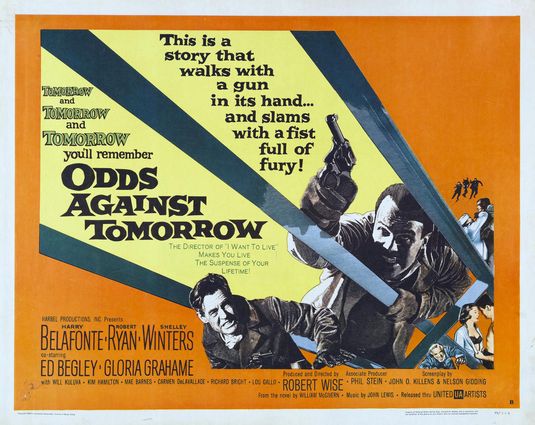
Odds Against Tomorrow (1959) - % % % %


Most noted for Harry Belafonte's role as a gambling addict, "Odds Against Tomorrow" is the first film noir to feature an African-American in a primary role. It is also a bleak film of failed lives overwhelmed by tension and fear, followed by rage. Produced by Belafonte's production company, the despairingly titled film works to give a context to racial tensions through the pitiable and harrowing lives contained by this heist flic.

The fascinating set of characters, mean and desperate, draw in the audience with their treacherous attempts at easing their struggles.

Robert Ryan costars as Earl Slater, a white ex-con with a chip on his shoulder and a temper to follow. He chafes at his inability to improve his lot or to avoid violence, ricocheting from bar fight to the door of his pretty, married neighbor, whom he degrades, manipulates and forcefully seduces.

As is often the case with films spearheaded by actors, the character development is primary to the script, and the action begins nearly halfway through the film, as Slater finally commits to a burglary scheme. Then he confronts his new partner, Belafonte, who is also desperate to cash in on the job to pay off his thug creditors from the race track. Slater's racism steams through his eyes and words, and the tension between the two is terrifying. There is no high ground. There is no noble character to raise the situation up to unify the two and bring them together. Instead, these troubled men are thrust together and head off to the heist. "It's gonna let us live again."

Best known for directing musicals like West Side Story as well as The Day The Earth Stood Still, director Robert Wise gives New York a harsh, frigid atmosphere. Bare trees and bitter winds penetrate the scenes, causing the actors to brace themselves against the world. Rather than filling this underworld with inky shadows, low angles peer up at the many shades of gray in this morally unhinged arena. Positioning the camera low to the ground, gives the impression of a towering weight about to fall on the characters at any moment. They appear isolated and imbalanced. Out on the streets, buildings loom up in the darkness; the sky is completely out of sight.
For a film about race and social issues, it holds up surprisingly well to this set of contemporary eyes. The score, although occasionally distracting, serves to layer anxiety and 50's jazz strains and intrigue. The conclusion gives the film the feeling of a morality tale, distracting from the potent tension created by these two actors. If the ending had only retained the seething interactions which engage the audience the most, this would have been a far more satisfying film.

Monday, December 13, 2010

Black Swan - % % % %


Startling and hallucinatory, Black Swan is a psychological horror story. Nina, played with every muscle by Nathalie Portman, achieves her lifelong dream of playing the Swan Queen in her ballet company's production of Swan Lake. Nina is a fragile perfectionist dominated by her live-in mother, a former dancer herself. Nina is already fraying at the edges from the physical pressures of professional ballet, so the elevation to her new role and the challenges, amplified by her director's sexual manipulations, lead her down the rabbit hole.

To succeed, we are told, one must give everything of themselves with abandon. Be free in the full sacrifice to one's craft. The greatest artists, athletes, whatever one admires, completely immerse themselves in their passion and are dedicated to perfection, n'est-ce pas? Nina releases her ego and identity in the complete submission of herself in the role of prima ballerina and she dissolves.

Directed by Darren Aronofsky, the film excels in this dissolution of reality. No other director achieves such a tangible, empathetic form of fear and nausea at the destruction of the human body. I left the theater after seeing Requiem for a Dream, thankful for my arms and for never having been so desperate or tragic in my life to succumb to prostitution. "Black Swan" makes me so grateful for the solidity of my body and my fingers and my bones and the entire thing. He achieves a rare squeamish terror that directors of Saw films should envy.


Furthermore, the disorientation of the climax and finale is complete and unpredictable. Unlike a film such as "Shutter Island", there are no explanations drawn out for the audience. The events swirl around Nina like the hallucinations they are. I've never seen such an accurate portrayal of the effects of Ecstasy on film. That alone is quite impressive. Nina's identity refracts like shattered mirrors as her self becomes her only real human connection and as she disintegrates into her new role.

Her body, her ultimate tool, rejects her and transforms itself, or perhaps she unconsciously transforms herself. Like a neurotic twitch that one cannot restrain, her skin and fingers and blood begin to alter against her will. A ballerina must be a master of her body, and her bulimia enables an illusion of physical and psychological control.

She is fragile and pale, like an egg, and as the pressure increases she cracks in a messy, messy way. It's exhilarating and spectacular and queasy and actually scary.

The casting is fantastic with the former prima, whom Nina replaces, played by Winona Ryder, and the new challenger played by Mila Kunis, who I am delighted to see in a drama. She is fantastic and utilizes her charisma to seduce with danger, rather than self-deprecating humor. The director of the company is slyly portrayed by Vincent Cassel using his sexuality and authority to embody that special kind of manipulative, seductive machismo. Rounding out the cast is Deborah Winger as the mother. She is quite terrifying yet believable. She resists the caricature of the failed mother living through her daughter and deftly plays the mind games of the most brilliant passive-aggressive matriarchs. Nathalie Portman deserves award considerations. She carries the film. Her character is nearly hysterical through the whole film yet she never becomes shrill or irritating. At the open of the film, I was saddened that such a good actress should immediately call to mind the stilted dialogue of Padme from Star Wars. To my relief she obliterated that character from my mind with her passion in this new role.

I will say as a draw back that the sound effects, while effective, were occaisionally over done and comical at first. Such a hallucinatory film is difficult for an audience to transition into at first and the sound effects just felt goofy for the first quarter of the film. Even towards the end, I found them heavy handed.

The pacing of the film was excellent and reminded me of the great psychological thrillers of Hitchcock. I am extremely impressed and thrilled that Aronofsky has returned to such dream-like territory. He is, in my opinion, at his best and most unique when creating a whirl-wind of the mind. His dryer character drama, "The Wrestler" was epic and poignant. But it lacked the joy and magic of creation that Aronofsky holds. If you are capable of extraordinary flights of fantasy, I'm not sure why you would ever tell such a miserable story, no matter how well told or illuminating it is. It'd be like Terry Gilliam directing Erin Brockovich. Why? And I think The Wrestler was a fantastic story of great depth and interest. I'm just so thrilled to get more from Aronofsky's imagination.

There is so much more I could say about the body manipulation inherent in such religious ferocity and the self-destructive commitment to success and work as a form of enslavement. What is success for? Is anyone really remembered in our ADD society? Are professional athletes any different than this woman crushing her toes to be beautiful? Is the drive for success always based in a lack of self-confidence and a frailty of identity?

Awesome. Scary. Trippy. Cool.

Saturday, December 11, 2010

You accidentally came to my website and welcome!

I am thrilled by this new addition to the blogger arsenal. Se here's the tracking of where my visitors have been from in the past. Pretty nifty.

Pageviews by Countries
United States 20
India 3
Switzerland 2
Spain 2
United Kingdom 2
Greece 2
Australia 1
Canada 1
Iceland 1
Jamaica 1

Since I don't know anyone in Greece or Jamaica, I'm going to guess that all the other views are also people who wandered here from Google. I hope you found it interesting. Now that I have confirmation that this blog does get some views even with the previously crummy way I've been keeping it, perhaps I shall be better motivated to improve my content. I am having an oddly sincere and probably nonstrategic moment, but I confess that I would like to offer something of value to the internet. I like processing my ideas about films through reviews, which could be useful for others. I'm not sure what will be most appealing for an audience. I'll mull it over, but if anyone has suggestions, I'm open to 'em. Thank you for visiting.

The Road - % % % % %


I have not seen such an engrossing and encompassing film in many months. Something about the intensity of the genre demands the audience's attention, and yet this film was more penetrating in its sparseness and more emotional in its anonymous performances, making none its equal.

Marvelous. It is a miserable story. At its core is the essence of why we live. In creating a truly desolate world, the story from the novel "The Road", by Cormac McCarthy, strips away the other concerns in life that we are cluttered with living in modernity. This leaves the hunt for food, the fear of danger and violence and then the radical question, why live at all?

After an unknown apocalypse of such extreme proportions that all life aside from human has ceased, a father and son head south. Flashbacks expand on their situation, telling the backstory of a wife and mother, Charlize Theron, who finally gives up so completely and, spoiler alert, removes her layers of warm clothing to walk into the dark and cold wild. Alone with the boy, the man, masterfully played by Viggo Mortensen, trudges along fighting to get the boy to an age when he can survive on his own or prepare himself for the likelihood of merciful suicide. The film deftly allows in the most gruesome of realities without reveling in their monstrous power. Many of the surviving people have taken to cannibalism since all of the animals and plants are dead. The horrors of this environment are acknowledged and momentarily explored to establish the extreme danger for the pair, but are not embraced with prurient thrill as is often the case in the apocalyptic genre. The film is filled with fear and allows horror, but is more elegant than a more base thrill or shock. Rather, it holds the suspense of morality at its core. Is this the right decision? Can I live with this choice? What will be the consequence of my decision? And the suspense of these moments does not fade in the resolution of the events because the mind holds the tension of such moments long after they have passed.

This is a story written with a masterful understanding of the human condition at its essence. It is brilliant.

The film is dominated by gray and dirty landscapes of dead trees and decayed society. Interspersed with poignant close ups of hands clutching at tenderness and tears trickling down worn cheeks, the story keeps the man and his son at the center. They don't have names. They are unnecessary in this world since other people are a danger, and everything unnecessary has been stripped away. There are moments of joy interspersed accidentally in their journey. A swim under a waterfall. A discovered can of coke. The embroidered couch cushion with blue flowers in his parents' living room. Some elements of modern life that we occupy ourselves with remain in this wasteland.

The performances are universally real and compelling. I can't imagine how a director was able to elicit such a performance of raw fear, vulnerability and justice from a child. Extraordinary. The scenes involving strangers like Robert Duvall, Guy Pierce and the underused Michael K. Williams
(c'mon and hire this man more, people! He is Omar from the wire and the most extraordinary actor from the whole series! That man needs a better agent!) are filled with fear, curiosity and tenderness. They allow the film to breathe, filling moments with the real grace of life, human connection. And that is what leads to the unexpected happiness of the ending. It seems unimaginable until it finally happens and is in parallel with sparse, barren nature of the film. This visual metaphor, the boy and the man alone in a barren world illuminates the core of the story. Human connection is the reason for life. It's the reason to go on. It is what love is. It is what life is. I am astonished by the profundity elicited by this film and moved by how effective it is in pervading an audience with its story and themes. Magnificent. Magnificent.

Director John Hillcoat's previous film "The Proposition" takes another raw genre centered around survival and the human condition, the Western, and offers a bleak and cruel perspective as well, but not to the same effect. In The Proposition, familial loyalty is tested and the situations never create enough tension to mentally shake the audience into philosophical crisis in the same way that he manages to in The Road. And he's Canadian. I didn't think it possible for a country with a functioning NHS and little poverty to speak of to produce such a morose dude, but I guess those long winters can put one in touch with the power of bleakness. Really a fantastic movie. Brilliant.

Monday, November 15, 2010

Great Migrations - TBD


I am becoming a great aficionado of nature docs. Perhaps the great turbulence of human lives has become too much for me to endure on a regular basis. Nature docs offer a meditative beauty and a sense of scientific assuredness at their core.

Watching my first installment of "Great Migrations", I am struck by the power of the narrator. Don't get me wrong. Alec Baldwin is no David Attenborough. Attenborough's joy and tenderness make him second to none. But I love the poetic turn that Baldwin brings to this new series. I can't imagine Oprah pulling off describing the sun as "the great watch-maker". Instead of the humanizing folksiness attempted in "Life", "Great Migrations" astounds with the drama inherent in the ebbs and flows of the non-human world. The cinematography may not be as staggering as in 'Life', but this is entirely to "Great Migrations"' advantage. Rather than spending all of their money on a few shots and then replaying them in different segments, "GM" seems to be focusing its attention on the stories of the critters and the poetry of the dramatics. The direction of this series is actually quite touching and mesmerizing.

The creation of this series by National Geographic, rather than the Discovery Channel, aids the production in another way. National Geographic rightly should be the premiere creators of nature docs from the US. "Great Migrations" includes a clarifying device that other producers may not be able to produce with as much grace and precision: maps. It is so important to orient the stories. I hate being distracted, wondering where this is taking place.

All in all, I'm impressed and eager for the next installment. I sure do hope that they don't recycle stories and repackage shots like 'Life'. It ruined the entire series, but I guess there wasn't much there in the first place.

And now I'm off to watch Nature on PBS. It's about Wolverines!

Saturday, November 6, 2010

American Experience: We Shall Remain - % % % % %


It never ceases to amaze me how little I know about North American Native American peoples. I learned all about Aztecs, Maya, Incas and Nazcas. But I know diddly about Algonquin or Shawnee people and culture.

This series is beautifully constructed of recreated scenes and interwoven interviews with historians and descendants of the historical figures. Watching the first episode I was struck over and over how enlightening this program is. Our children's history books are mediocre and fail all of us.

500 Days of Summer - % % %


Nestled inside a nifty structure, moving throughout a relationship by days from middle to beginning to end, is a romantic comedy of mediocre and flimsy proportions. Zooey Deschanel and Joseph Gordon-Levitt carry the film admirably, but from the very beginning the narration indicates that this film is filled with crummy people who do stupid things and aren't worth our time. Really. The film tells us that these people suck at the beginning of the movie. Joseph Gordon-Levitt's character Tom is shown in flashback as a child and we are told that he sadly misunderstands love, and then we learn that Deschanel's character, Summer, gets everything more easily in life because she is cute. From the beginning we are told not to trust or respect the main characters. Bleck. Why should we want to watch this movie then?

I have a nit-picky problem with this film as well. According to the film, these characters are two years younger than me. There were no eight-year-olds listening to Joy Division when I was 10. I knew who they were because of my brother, seven years older than I. As I pieced together the time-line of Tom's life, I think this screenplay is 10 years old and no one thought to up-date it. In the intro, we see Tom as a child listening to "bad British pop music" while wearing a Joy Division t-shirt. Joy Division was British, but they were neither pop music nor bad. This is a total mis-characterization of the music. This odd misunderstanding of the music indicates a misunderstanding of the main character. If the screenwriter misunderstands this seemingly autobiographical story, how can the audience be expected to connect with the story?

I did get swept up in the the joyous moments, like the choreographed dance sequence following the consummation of the relationship. And while I enjoy a nicely designed set and costumes, this film went into a nauseatingly heavy-handed cutesy-ness of 60's sharp suits and brunette bangs. Heck, they play house in a set of Ikea furnished rooms, as if their romance is entirely an idealized facade. The film, like the furniture, may look cute at first, but it's made of hollow cardboard and won't hold up. A film like "Singles" is a great example of capturing a style or music scene without overloading the film and crushing what little substance it may contain. Perhaps this has to do with the particular style of the film, rooted in child-like illustrations and clean, sharply-styled 60's fashion. Such a style resists a productive outlet for anger or depression. It is meant to evoke nostalgia, innocence and polish. It's exhausting even midway through the movie.

No one seems to have a sense of humor about themselves either. They are all so serious and sincere. Early on in the film we see Tom smashing plates in his kitchen, devastated at the loss of Summer, who just isn't that into him (no better explanation is ever offered). It's ridiculous but no one laughs at it. His precocious little sister speaks sage wisdom in a monotone to him trying to set him straight. A little laughter might release the intense pressure in Tom to hang on to his crummy relationship. A little levity and humorous self-reflection might endear the audience to the characters. In the end, Tom meets Autumn and starts it all over again. Bleck.